Sunday, May 11, 2014

"...nothing to writing. All you do is sit down at a typewriter and bleed."


"There is nothing to writing. All you do is sit down at a typewriter and bleed." --Ernest Hemingway


My last post introduced you to the four groupings of short stories that have really jazzed me over the years.  They were not in any way hierarchical, that is, Group I doesn't mean Top Shelf.  Actually, I'm pretty sure I ordered them alphabetically by first name when I started and then mixed them up so as not to be too orderly.  (And me, having worked in the Lincoln Jr. High School and Orville H. Platt High School libraries.)

Now this is the second post, and so it's the second group; not second-best.  I don't get paid to rate the writers, I don't get paid.  This is a sheer Love-of-Writing flag that I'm waving.  I'm encouraging you to read them.

II.  Ernest Hemingway, Eudora Welty, Flannery O'Connor, Frank O'Connor, Franz Kafka, G.K. Chesterton, Grace Paley, Guy de Maupassant, H.H. Munro (Saki), H.P. Lovecraft

#1  Ernest Hemingway
(1899-1961)
It wasn't until I started college that I began to read all of Hemingway's stories.  One that grabbed hold of me so profoundly was "Big Two-Hearted River."  I found a stripped copy of the Nick Adams Stories in a Five and Dime store in Meriden (Conn.), after I'd moved back there during the summer of 1975.  They'd made a great impression on a highly impressionable young man.  


#2  Eudora Welty
(1909-2001)
"..When I did begin to write, the short story was a shape that had already formed itself and stood waiting in the back of my mind.  Nor is it surprising to me that when I made my first attempt at a novel, I entered its world--that of the mysterious Yazoo-Mississippi Delta--as a child riding there on a train: "From the warm window sill the endless fields glowed like a hearth in firelight, and Laura, looking out, leaning on her elbows with her head between her hands, felt what an arriver in a land feels--that slow hard pounding in the breast." -[from One Writer's Beginnings by Eudora Welty]

#3  Franz Kafka
(1883-1924)
"...we need books that affect us like a disaster, that grieve us deeply, like the death of someone we loved more than ourselves, like being banished into forests far from everyone, like a suicide. A book must be the axe for the frozen sea within us. That is my belief.” [Franz Kafka]


#4  Flannery O'Connor
(1925-1964)

"From my own experience in trying to make stories 'work,' I have discovered that what is needed is an action that is totally unexpected, yet totally believable, and I have found that, for me, this is always an action which indicates that grace has been offered. And frequently it is an action in which the devil has been the unwilling instrument of grace."  [Flannery O'Connor]

#5  Frank O'Connor
(1903-1966)
Q: Why do you prefer the short story for your medium?
Frank O'Connor: "Because it’s the nearest thing I know to lyric poetry—I wrote lyric poetry for a long time, then discovered that God had not intended me to be a lyric poet, and the nearest thing to that is the short story. A novel actually requires far more logic and far more knowledge of circumstances, whereas a short story can have the sort of detachment from circumstances that lyric poetry has."   [The Paris Review, Autumn-Winter 1957]

#6  G.K. Chesterton
(1874-1936)

"I like detective stories; I read them, I write them; but I do not believe them. The bones and structure of a good detective story are so old and well known that it may seem banal to state them even in outline. A policeman, stupid but sweet-tempered, and always weakly erring on the side of mercy, walks along the street; and in the course of his ordinary business finds a man in Bulgarian uniform killed with an Australian boomerang in a Brompton milk-shop. Having set free all the most suspicious persons in the story, he then appeals to the bull-dog professional detective, who appeals to the hawk-like amateur detective. The latter finds near the corpse a boot-lace, a button-boot, a French newspaper, and a return ticket from the Hebrides; and so, relentlessly, link by link, brings the crime home to the Archbishop of Canterbury.”  [G.K.Chesterton as quoted in Illustrated London News, May 6, 1911]


#7  Grace Paley
(1922-2007)

Q: How do stories begin for you?
Grace Paley:  A lot of them begin with a sentence—they all begin with language. It sounds dopey to say that, but it’s true. Very often one sentence is absolutely resonant. A story can begin with someone speaking. “I was popular in certain circles,” for example; an aunt of mine said that, and it hung around in my head for a long time. Eventually I wrote a story, “Goodbye and Good Luck,” that began with that line, though it had nothing to do with my aunt. Another example: “There were two husbands disappointed by eggs,” which is the first sentence of “The Used-Boy Raisers.” I was at the house of a friend of mine, thirty-five years ago, and there were her two husbands complaining about the eggs. It was just right—so I went home and began the story, though I didn’t finish it for months.  ...The sound of the story comes first."  [The Paris Review, Fall 1992]


#8  Guy de Maupassant
(1850-1893)
"A man forced to spend his life without ever having the right, without ever finding the time, to shut himself up all alone, no matter where, to think, to reflect, to work, to dream? Ah! my dear boy, a key, the key of a door which one can lock — this is happiness, mark you, the only happiness!"  [from Maupassant's The Question of Latin]


#9  H.H. Munro (Saki)
(1870-1916)
"Reginald sat in a corner of the Princess's salon and tried to forgive the furniture, which started out with an obvious intention of being Louis Quinze, but relapsed at frequent intervals into Wilhelm II.
He classified the Princess with that distinct type of woman that looks as if it habitually went out to feed hens in the rain.  Her name was Olga; she kept what she hoped and believed to be a fox- terrier, and professed what she thought were Socialist opinions. It is not necessary to be called Olga if you are a Russian Princess; in fact, Reginald knew quite a number who were called Vera; but the fox-terrier and the Socialism are essential."  [from Munro's Reginald in Russia]

"My aunt will be down presently, Mr. Nuttel," said a very self-possessed young lady of fifteen; "in the meantime you must try and put up with me."  Framton Nuttel endeavored to say the correct something which should duly flatter the niece of the moment without unduly discounting the aunt that was to come. Privately he doubted more than ever whether these formal visits on a succession of total strangers would do much towards helping the nerve cure which he was supposed to be undergoing." [from Munro's The Open Window]


#10  H.P. Lovecraft
(1890-1937)

"I am Basil Elton, keeper of the North Point light that my father and grandfather kept before me. Far from the shore stands the grey lighthouse, above sunken slimy rocks that are seen when the tide is low, but unseen when the tide is high. Past that beacon for a century have swept the majestic barques of the seven seas. In the days of my grandfather there were many; in the days of my father not so many; and now there are so few that I sometimes feel strangely alone, as though I were the last man on our planet."  [from Lovecraft's The White Ship]


Saturday, May 3, 2014


Like the endless floor-to-ceiling over-stocked shelves at Costco, my friend Joe Savino keeps his friends and family well stocked with Lists, articles about Lists, articles for Lists, and articles against Lists, Lists of Lists, missing Lists, and the Lists nobody knows about.

Often these Lists are hierarchical, and are cause for argument and suspicion, hilarity and the woeful shaking of one's head, and usually they drive us crazy; they drive HIM crazy, and that's why he shares them with us.  "Can you believe they said that book was the best?"  "Can you believe they said that movie, or that politician, or that historical figure,...?"

Now here, for your benefit, Reader, is a list, not my list, not The List, but a List, a vertical touchstone, a reminder of some very good, memorable, outstanding, collections of Short Stories that perhaps you might have read, wanted to read, or didn't know about.  Who's to say?

Certainly, many other writers have written short stories, a collection or two has been published, but I'm leaving out writers who were known more for their longer forms, like Camus, F. Scott Fitzgerald, Dawn Powell.  The people listed below, at least in my mind, not only raised the bar of the short story, but raised the bar of literature, of culture, intelligence, empowerment, enlightenment, and entertainment.

I know you'll say, but J.D. Salinger's body of work?  Only the Nine Stories volume and a few uncollected ones?  That qualifies?  Yes, it does. What Salinger did for us with that one volume was to set us on fire.  Nevertheless, I highly recommend them all.  They are Titans.

So as not to overwhelm our eyes and cognitive skills, I'm posting the list in groups of ten per post:

I.  Algernon Blackwood, Conrad Aiken, Ambrose Bierce, Bernard Malamud, Doris Lessing, Edgar Allan Poe, Edith Wharton, Barry Hannah, Sir Arthur Conan Doyle, Anton Chekhov

II.  Ernest Hemingway, Eudora Welty, Flannery O'Connor, Frank O'Connor, Franz Kafka, G.K. Chesterton, Grace Paley, Guy de Maupassant, H.H. Munro (Saki), H.P. Lovecraft

III.  Henry James, Irwin Shaw, Isaac Bashevis Singer, Ivan Bunin, Jack London, J.D. Salinger, John Cheever, Joseph Mitchell, Katherine Ann Porter, Nathaniel Hawthorne

IV.  O. Henry, P.G. Wodehouse, Ray Bradbury, Rudyard Kipling, Shirley Jackson, Stephan Crane, W. Somerset Maugham, William Faulkner, William Trevor

I.

#1


Algernon Blackwood
( 1869-1951)
  "...one of the most prolific writers of ghost stories in the history of the genre." [Wikipedia]


#2 Conrad Aiken (1889-1973)


"Just why it should have happened, or why it should have happened just when it did, he could not, of course, possibly have said; nor perhaps could it even have occurred to him to ask. The thing was above all a secret, something to be preciously concealed from Mother and Father; and to that very fact it owed an enormous part of its deliciousness." [from Silent Snow, Secret Snow.  Below is a YouTube link to a dramatized version of this great story, courtesy of Jasper Simon]


Conrad Aiken was also largely responsible for establishing Emily Dickinson's reputation as a major American poet.  Malcolm Cowley referred to Aiken as "the Sleeping Giant of American Letters." 

#3
Ambrose Bierce
(1842-1914)


 He is most known for the short story "An Occurrence at Owl Creek Bridge" and compiled a satirical lexicon, The Devil's Dictionary

#4
Bernard Malamud (1914-1986) "Life is a tragedy full of joy."

"Malamud is renowned for his short stories, often oblique allegories set in a dreamlike urban ghetto of immigrant Jews. Of Malamud the short story writer, Flannery O'Connor wrote: "I have discovered a short-story writer who is better than any of them, including myself." He published his first stories in 1943, "Benefit Performance" in Threshold and "The Place Is Different Now" in American Preface. In the early 1950s, his stories began appearing in Harper's Bazaar, Partisan Review, and Commentary.
The Magic Barrel was his first published collection of short stories (1958) and his first winner of his first National Book Award for Fiction[6] Most of the stories depict the search for hope and meaning within the bleak enclosures of poor urban settings."

[Citation courtesy of Wikipedia]

#5
Barry Hannah (1942-2010)  “The Deep South might be wretched, but it can howl.”


Hannah produced five collections of short stories from 1978 to 2010.  "[His] lines invigorate and intoxicate, his language delivering us into an American version of what Rilke called “a more powerful reality — rising and circling, poised but wild.” Hannah was a storyteller, an enchanter with a refined eye for the outrageous and an ecstatic worldliness worthy of Rabelais. “Long, Last, Happy: New and Selected Stories” is a triumph: nearly faultless, every page a raging pleasure." [Justin Taylor, The New York Times Book Review]

#6 Sir Arthur Conan Doyle (1859-1930)


Aside from creating and popularizing the stories of Sherlock Holmes, Conan Doyle was also a prolific writer whose other works include fantasy and science fiction stories, plays, romances, poetry, nonfiction, and historical novels. 

#7  Edith Wharton (1862-1937)


  Wharton combined her insider's view of America's privileged classes with a brilliant, natural wit to write humorous, incisive novels and short stories of social and psychological insight. (from Wikipedia)

I especially liked "Roman Fever."

#8  Anthon Chekhov (1860-1904) "is considered to be among the greatest writers of short stories in history." (Encyclopedia Britannica)


File:Tolstoy and chekhov.jpg
Chekhov with Tolstoy

#9 Edgar Allan Poe (1809-1849)
is "best known for his tales of mystery and the macabre, Poe was one of the earliest American practitioners of the short story, and is generally considered the inventor of the detective fiction genre. He is further credited with contributing to the emerging genre of science fiction. He was the first well-known American writer to try to earn a living through writing alone, resulting in a financially difficult life and career.

#10 Doris Lessing (1919-2013)

 "...Mrs. Lessing's knowledge of women's anger and aggression, even more than of their sexuality, took people by surprise and categorized her. ...Her short fiction (except her African stories) should repair any misunderstanding of her timelessness, the breadth of her sympathy and range of her interests and, above all, the pleasures of reading her. Rereading [her] stories is like returning to a Victorian novel one loves, and affords the same delightful feeling of self-indulgence combined with self- improvement." [Diane Johnson, The New York Times]

(next post, 10 more)


Thursday, March 27, 2014

The proper function of fiction is to tell an interesting story--W. Somerset Maugham

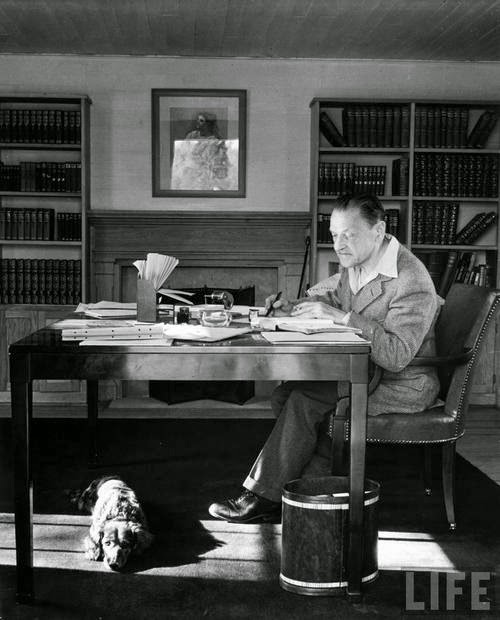
W. Somerset Maugham at home, writing at his desk.


"...the proper function of fiction is to tell an interesting story."

In 1952, W. Somerset Maugham said,


"The anecdote is the basis of fiction.  The restlessness of writers forces upon fiction from time to time forms that are foreign to it, but when it has been oppressed for a period by obscurity, propaganda or affectation, it reverts, and returns inevitably to the proper function of fiction, which is to tell an interesting story."

These excerpts are from his Preface to the 1952 edition of "The Complete Short Stories of W. Somerset Maugham, Volume 2, 'The World Over'"

"I have written now nearly a hundred stories and one thing I have discovered is that whether you hit upon a story or not, whether it comes off or not, is very much a matter of luck.  Stories are lying about at every street corner, but the writer may not be there at the moment they are waiting to be picked up or he may be looking at a shop window and pass them unnoticed."

In the 1930s, Maugham was the world's highest paid writer.


 "He may write them before he has seen all there is to see in them or he may turn them over in his mind so long that they have lost their freshness.  He may not have seen them from the exact standpoint at which they can be written to their best advantage."


"It is a rare and happy event when he conceives the idea of a story, writes it at the precise moment when it is ripe, and treats it in such a way as to get out of it all that it implicitly contains.  Then it will be within its limitations perfect."


 "But perfection is seldom achieved."

"I think a volume of modest dimensions would contain all the short stories which even closely approach it.  The reader should be satisfied if in any collection of these short pieces of fiction he finds a general level of competence and on closing the book feels that he has been amused, interested, and moved."

Maugham, in his office, Villa Mauresque, Cap Ferat, 1939

Maugham, W. Somerset.  The Complete Short Stories of W. Somerset Maugham, Vols. 1 and 2.  Garden City, NY: Doubleday & Company, 1952.

Saturday, March 15, 2014

"You know what home is."


New York, Long Island, Connecticut from space station
As I mentioned in my previous post, I am presenting, for a couple of days, excerpts from Diane Ackerman's book, A Natural History of the Senses.  Why I am doing this is explained in the 3/9/14 post.

Here, at the conclusion of the Vision section in her book, Ms. Ackerman reflects on her sensations and realizations after she'd had her first flying lesson. From pages 284-285:

"You know what home is.  For many years, you've tried to be a modest and eager watcher of the skies, and of the Earth, whose green anthem you love.  Home is a pigeon strutting like a petitioner in the courtyard in front of your house.  Home is the law-abiding hickories out back.  Home is the sign on a gas station just outside Pittsburgh that reads "If we can't fix it, it ain't broke."  Home is the springtime on campuses all across America, where students sprawl on the grass like the war-wounded at Gettysburg.  Home is the Guatemalan jungle, at times deadly as an arsenal.  Home is the pheasant barking hoarse threats at the neighbor's dog.  Home is the exquisite torment of love and all the lesser mayhems of the heart.  But what you long for is to stand back and see it whole.  You want to live out that age-old yearning, portrayed in myths and legends of every culture, to step above the Earth and see the whole world fidgeting and blooming below you."

For a little ambiance while you read, I've inserted here one of Ms. Ackerman's favorite pieces of music; she listens to it obsessively before she begins to write.  I give you the Adagio, from Allessandro Marcello's Oboe Concerto in d minor. 


Embedded video & music courtesy of Ron de Leeuw, The Netherlands.


Monterey Bay, California from space

Images courtesy of NASA.

Friday, March 14, 2014

"The visual opium of the sunset was what I craved."

Sunset in Missouri, courtesy of Dianne Irey McDonald
As I mentioned in my March 9th post, I will be presenting, for a couple of days, excerpts from Diane Ackerman's book, A Natural History of the Senses.  Why I am doing this is explained in that post. Today, I have a piece for you from the Vision section, pages 255-256:


"Some years ago, when I had taken a job directing a writing program in St. Louis, Missouri, I often used color as a tonic.  Regardless of the oasis-eyed student in my office, or the fumings of the hysterically anxious chairman, I tried to arrive home at around the same time every evening, to watch the sunset from the large picture window in my living room.

Each night the sunset surged with purple pampas-grass plumes, and shot fuchsia rockets into the pink sky.  The visual opium of the sunset was what I craved.
Sunset at Creve Coeur Lake, in Missouri.

Next day, ...I stood chatting with one of the literary historians.  I was paying too much rent for my apartment, she explained.  True, the apartment overlooked the park's changing seasons, and was only a block away from a charming cobblestone area full of art galleries, antique stores, and ethnic restaurants.  But this was all an expense, as she put it, with heavy emphasis on the second syllable.

That evening, as I watched the sunset's pinwheels...I thought: the sensory misers will inherit the earth, but first they will make it not worth living on."


Sunday, March 9, 2014

Diane Ackerman's A Natural History of the Senses


A couple weeks ago I finished reading Diane Ackerman's beautiful book, A Natural History of the Senses.
  I still can't get it out of my head, and during the read I almost daily regaled my friends Theresa and Joe with reading aloud small excerpts about something she says on Vision, or Touch, or Smell, or Taste, or Hearing.  I'll still reference something from her even on my walks with Joe to the library, or on a Sunday afternoon, wielding a knife while I'm making a vegetable & cheese platter in anticipation of wine and Canasta with Theresa, and Joe with a beer and the Los Angeles Times.  Besides the fascinating scientific insights that she imparts about our senses, her prose draws you in like a lover holding the bed covers open for you to slip inside.

This is one of several excerpts I'm going to post; it's from page 256:

"When you consider something like death, after which (there being no news flash to the contrary) we may well go out like a candle flame, then it probably doesn't matter if we try too hard, are awkward sometimes, care for one another too deeply, are excessively curious about nature, are too open to experience, enjoy a nonstop expense of the senses in an effort to know life intimately and lovingly.  It probably doesn't matter if, while trying to be modest and eager watchers of life's many spectacles, we sometimes look clumsy or get dirty or ask stupid questions or reveal our ignorance or say the wrong thing or light up with wonder like the children we all are.  It probably doesn't matter if a passerby sees us dipping a finger into the moist pouches of dozens of lady's slippers to find out what bugs tend to fall into them, and thinks us a bit eccentric.  Or a neighbor, fetching her mail, sees us standing in the cold with our own letters in one hand and a seismically red autumn leaf in the other, its color hitting our senses like a blow from a stun gun, as we stand with a huge grin, too paralyzed by the intricately veined gaudiness of the leaf to move."

 [Ackerman, Diane. A Natural History of the Senses, New York: Vintage Books, 1991.]


Sunday, March 2, 2014

Steven Pressfield's The Afghan Campaign. Some things never change.


     “...that which binds the individual to the family, the tribe, and the ancestors.  Most important are the ancestors.  When they turn their backs on you, God turns his back, too.”

     I tell him about Shinar and the burden of shame she seems to bear.  He affirms this.

     “You should have killed her,” he says, “instead of protecting her.”

     The crime I have committed, Elihu explains, is called...al satwa.  It means to bring shame upon someone by performing an act of responsibility that they have failed to perform themselves.

     “If a stranger stops at my father’s gate,” Elihu says, “and my father has no food to offer, this is unfortunate but no crime.  If our neighbor, however, then provides a meal to the stranger, he has committed al satwa against my father.  Do you understand, Matthias?  The neighbor has shamed my father before the stranger.

  This is a terrible transgression in our country.  The crime is even worse in your case, for you have rescued a sister when her brother should have done so.  You have shamed him mortally, do you see?”
      “Well, where the hell was he,” I ask, “when Shinar needed him?  I wouldn’t have had to do anything if he had been there to look out for her!”

     “Exactly.”

     “He should be grateful to me!  Haven’t I defended his sister?  Haven’t I saved her life?”

     No, says Elihu.  “You have shamed this woman’s kin by doing for her what they should have done themselves--and for that, they can never forgive you.  As for her, she is the vehicle of this shame.  The ancestors have witnessed.  This is what she experiences now, being with you. And if you evoke feeling in her, her shame is double.”

     “In other words,” I say, “to an Afghan it would be preferable that Ash the muleteer continue to beat and abuse Shinar, even kill her, than that I should help her.”

     “Indeed.”

     “Or that ...some other scuff should rape and outrage her.”

     “Precisely,” says Elihu.

     All I can do is shake my head.

     “Every act of kindness you perform toward this woman will only drive her deeper into shame.”
(Excerpted from Steven Pressfield's The Afghan Campaign)


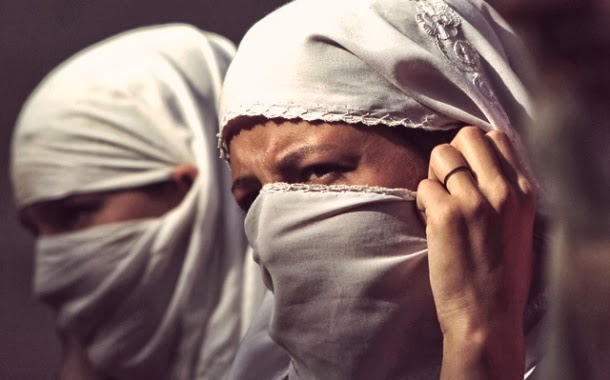
A couple of millenia have passed, and things haven't really changed over there. And things won't change.  Women are still subject to tertiary citizen status by ego-maniacal men whose oppression is supported by religious texts.  Or so they claim. Well, religious texts with AK-47s and RPGs.   In 2,000 years, the only change has been the weaponry, because the savagery wears the same face, the same clothes, exhales the same lies.  The country was a mess then, it's a mess now.

As I was reading Pressfield's book--and it is a good book, it's exciting, informative, monstrous in its realistic portrayal of the cruelties of war--it was impossible not to think of the current day's predicament of Western armies battling the Afghan tribes high in the mountains, or in the streets of Kabul or Herat or Kandahar.  It was impossible not to see the perfect comparisons between Alexander's troops in 330-327 B.C. and the Russians in 1979-1989 A.D.  Whether Bactrian tribes or Taliban, Sogdians and Pactyans or the mujahideen, there is still the invader, and there is still the tribe.

Alexander was chasing Oxyartes, Bessus, Spitamenes; Brezhnev, Andropov and their boys were after Massoud and Haqqani; we were after Osama bin Laden & friends.  In each case, although I benefit from over 2,000 years of historical record, I wonder continuously what was Alexander's point then, and what is our point now, in being there?
 Pressfield's book is not only a story of 330 B.C., it's a story of our time as well.