Saturday, June 18, 2022

Speaking well of Ford, Orwell, and Toer


Continuing with my embryo tradition of "the gleaning of great mentionables," that is, what I refer to in previous posts as my sharing great quotes and points of view, recollections, musings from the nonstop procession of literary gods and goddesses whom I have been reading, see Feb. 26, I have for you here Richard Ford, George Orwell, and Pramoedya Ananta Toer.

First, from the Indonesian version of Albert Camus, we have Mr. Toer's Child of All Nations.  Below, the narrator reflects on witnessing the sailing away of his young, beloved wife:

     The sun was moving slowly, crawling like a snail, inch by inch across the heavens.  Slowly, slowly--not caring whether the distance it had traversed would ever be traversed again.
     The clouds hung thinly across the sky, unwilling to release even a single spray of drizzle.  The atmosphere was gray, as though the world had lost its multitude of colors.
     The old people teach us through their legends that there isa mighty god called Batara Kala.  They say it is he who makes all things move further and further from their starting point, inexorably, towards some unknown final destination.  A human blind to the future, I could do no more than hope to know.  We never even really understand what we have already lived through.
     People say that before humankind stands only distance.  And its limit is the horizon.  ...There is no romance so strong that it could tame and hold them: the eternal distance and the horizon.

What killed me is the sentence "We never even really understand what we have already lived through."  I just love it.  I'm more than halfway through the novel, the second in his Buru Quartet.  It is not an easy, simple, humane life that Toer writes about, this turn-of-the-century (1901-ish) Dutch-conquered land of the future Indonesia.

From Richard Ford's book of short stories, Rock Springs.  This is a selection from the last story in the book, "Communist."  It's the narrator's response to a question his mother asks, that is, if she is still very feminine, she's 32, but she needs his truthful approval.

     And I stood at the edge of the porch, with the olive trees before me, looking straight up into the mist where I could not see geese but could still hear them flying, could almost feel the air move below their white wings.  And I felt the way you feel when you are on a trestle all alone and the train is coming, and you know you have to decide.  And I said, "Yes, I do."  Because that was the truth.  And I tried to think of something else then and did not hear what my mother said after that.
     And how old was I then? Sixteen. Sixteen is young, but it can also be a grown man.  I am forty-one years old now, and I think about that time without regret, through my mother and I never talked in that way again, and I have not heard her voice now in a long, long time.

What wrested my heart was the mention of the geese, that he "...could still hear them flying, could almost feel the air move below their white wings."  I've heard them, the mammoth glides of geese in their v-formations in Colorado, not just their honking but their wings.  And my sister Robyn has felt the air displaced, while walking or working in her garden, by the thousands that have flown overhead, east and west, constantly.  So it really resonated with me.  I highly recommend Rock Springs.

From George Orwell, in a piece he wrote toward the end of the war in Europe, from As I Please: Collected Essays, Journalism and Letters:

     So long as one thinks in short periods it is wise not to be hopeful about the future.  Plans for human betterment do normally come unstuck, and the pessimist has many more opportunities of saying "I told you so" than the optimist.  By and large the prophets of doom have been righter than those who imagined that a real step forward would be achieved by universal education, female suffrage, the League of Nations, or what not.
     The real answer is to dissociate Socialism from Utopianism.  Socialists are accused of believing that society can be--and indeed, after the establishment of Socialism, will be--completely perfect; also that progress is inevitable.
     ....Socialism is not perfectionist, perhaps not even hedonistic.  Socialists don't claim to be able to make the world perfect: they claim to be able to make it better.  And any thinking socialist will concede to the Catholic that when economic injustice has been righted, the fundamental problem of man's place in the universe will still remain.

I loved this little bit.  I have many socialist tendencies, and I know sometimes everyone goes too far somewhere, but like Orwell says, they "claim to be able to make it better" not perfect.  And that I adhere to.  I also loved the little bit about pessimism.

Well, thanks for listening, and leave the light on for me, will you?


Saturday, February 26, 2022

Speaking Well of Muriel Spark and Glenn Gould

A fabulous by-product of reading biographies is the gleaning of great mentionables, great quotes and points of view or recollections that though not yours you get to claim in a way because you've read the book, you've "done the work," at least, in some fashion.  No? Yes?

What's the point of reading a book if you can't revel in it, if you can't praise it and talk about it to the point of exhaustion, that is, when appropriate?  I just finished Jasper Fforde's early novel, The Eyre Affair, and posted the cover and my gushing about it on Instagram.  It's what one does! Yes? No? And during my sojourn in Colorado, if I was going to be awake until the wee hours of the morning because of pain medications and my broken ankle and shattered shin, I might as well (and I did) use those hours to good advantage by taking delight in Horace Afoot by Frederick Reuss, Brazzaville Beach by William Boyd, The Square by Marguerite Duras, The River Between by James Ngugi, and A German Requiem by Philip Kerr.

So, preamble aside, let me boast the renowned Canadian classical pianist, Glenn Gould (1932-1982).  The 1989 biography by Otto Friedrich was a fascinating experience, to say the least.  For instance--

    “I’ve always had some sort of intuition,” Gould once said, “that for every hour you spend in the company of other human beings you need X number of hours alone.  …isolation is the indispensable component of human happiness.”

I love that.  Then there's this recollection of Leonard Bernstein's, as per Friedrich--

    Glenn Gould’s The Goldberg Variations had appeared when Bernstein's wife, Felicia, was pregnant with their first son. While she had to wait out the last month during a New York heat wave, that record became their “song.”
    Yet Bernstein's most vivid personal memory of the young Gould came slightly later, when they were preparing to record the Beethoven C minor Concerto, and Bernstein invited the pianist to dinner at his place in the Osborne apartment house, just across from Carnegie Hall.
    “He was all bundled up,” Bernstein recalled, sipping on his Scotch and soda and taking another cigarette from his silver cigarette box, “and he had an astrakhan hat over some other kind of cap, doubly hatted, doubly mittened, and endlessly muffled and muffiered. And Felicia said, ‘Aren’t you going to take your hat oft?’ He said, ‘No, no, that’s all right, I’ll keep it on.’
    “A few minutes later, she asked me, in an aside over drinks, whether this was a religious matter with him, and I said ‘As far as I know, it isn’t!’ So she brought it up again to him and said, ‘Really, I think you ought to take your hat off, if you don’t have any reason for having it on, because it’s very warm.’
    “And you know, he did. And when he had taken his hat off, Felicia said, ‘But this is impossible!’ I mean, he had--this was a mat of hair, soaking wet, and just unnourished, and no air. It was hair that hadn’t breathed in God knows how long. And while I was fixing drinks or something, she lured him into the bathroom, sat him down at a stool and cut his hair. And washed it, and combed it. And he came out looking like some kind of archangel, radiant, with this beautiful hair which one had never seen the color of, quite blond, and thinning, haloed-ish. It was really a very beautiful thing to see, what she did, his acceptance, equally beautiful, and the result, which was thrillingly beautiful.”

And then let me boast a quote or two from the Scottish novelist Muriel Spark (1918-2006)--

"…[it is] the moment of illumination which every artist experiences at one time, a kinship with that primitive order of religious revelation.  That is the paradox of inspiration--the incredible and the impossible are felt to be present and therefore (for what is more actual than what we feel?) are credible and possible.  If such an experience, a mystical revelation, is “unutterable,” if the inspiration itself cannot be conveyed, the work of art which is its flower will probably spring where the seed is sown.  The poem will have an organic connection with its physical origin, and the pattern of events and their movement at the visionary instant will be translated symbolically until in the end the work itself becomes the real thing and the events the symbols of it."

Well, that got me.  Then, from her biographer, Martin Stannard, this piece--

"...her poem “Chrysalis” describes how she and Derek Stanford had, one London winter, placed a chrysalis in a matchbox and “in cold spring” been at first puzzled to discover a butterfly in their room. The reader is invited to celebrate release, transformation. Muriel, or Muriel’s spirit, is figured as “the pretty creature” emerging from the hard “broken shell,” “whispering about the curtain,” and then out of the window, away from the “small violence.”


It's the "small violence" that really moved me.


Bibliography:

Stannard, Martin. Muriel Spark: The Biography, New York: W.W. Norton & Company, 2010.

Friedrich, Otto.  Glenn Gould: A Life and Variations, New York: Random House, 1989.

Sunday, February 20, 2022

During a snowfall, looking out at my sister's backyard.

How I Spent My Winter Holiday With a Fractured Ankle and Broken Shin Bone


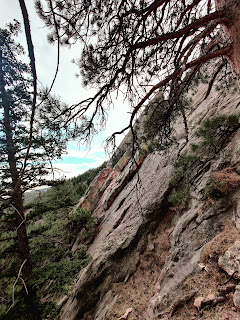
December 23, 2021. My sister Robyn and her son, Kenji, and myself.  A trip to the "Flatirons," part of Green Mountain, in the Colorado Front Range of the Rockies, above Boulder, Colo.* 

In the words of a very funny and annoying TV character, "On my behalf," I didn't know we were actually going hiking, and so just wore my sneakers.  At 3:00 pm, I texted Joe Savino my whereabouts, as we'd climbed to 7,000 feet.  I was exhausted needless to say.  "Take it easy," said Joe, "stop if you begin to lose your breath.  This is a 'no hero' holiday!" His words as true as they were I heeded, but...

By 3:46 pm we'd made it to the top of the Flatirons.  We rested, looked around at the gullies and preponderance of trees, Kenji explained why we can populate Mars within his lifetime.  I was skeptical.  Knowing how we've had trouble landing on Mars with robotic ships, sending humans into space for years with no technology to get them back is a huge problem.
Kenji explaining


At 4:37 pm, Robyn texted Joe that I had slipped and hurt my ankle.  "[The] Team is coming up, everything is okay."  Like what would that mean?  The Team?  It was the Rocky Mountain Rescue Group (RMRG), based in Boulder, Colo.  It was impossible for me to stand let alone walk down the mountain.

At left, a photo taken by Robyn just after she got me to sit up and away from the sliding dirt and stones and pine needles.  I'd already had two brushes with fainting, and I'm as pale as a ghost.  Pathetic man, waiting for the cavalry.

Just after sunset, the RMRG, numbering about 17 professionals (from ER doctors, fire fighters to EMS techs, nurses) showed up with a stretcher, blanket, inflatable caste, and ropes. 


They subsequently escorted Robyn and Kenji down the mountain ahead of me so as to enable them to utilize the trail as best as could be expected since it was dark.


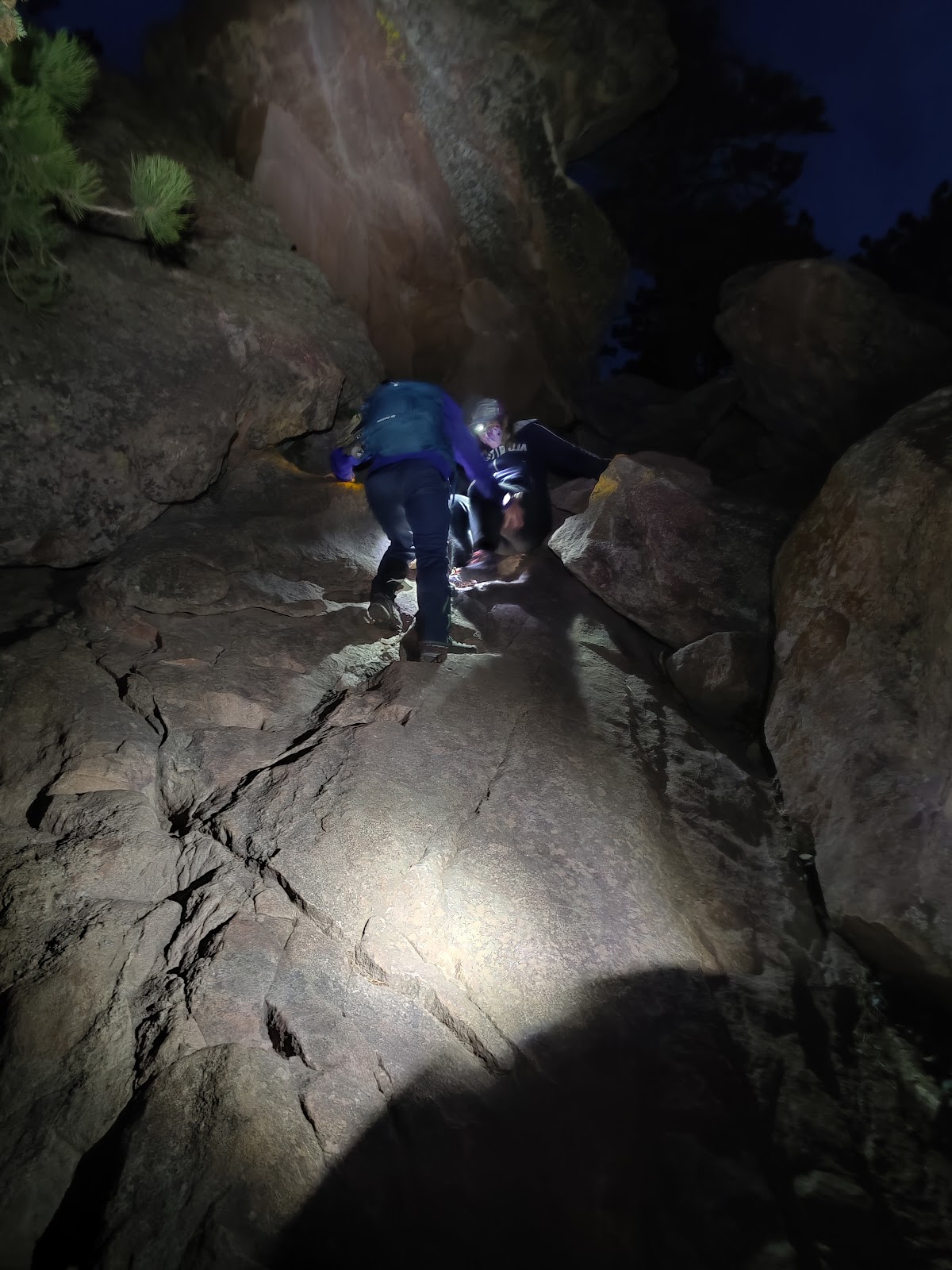
I was strapped into the stretcher, helmet placed on my head, covered in an orange blanket with two mountaineers on either side of the stretcher, two in the front, and one in the back; supported by others "behind the scene" with rope tied around boulders and thick tree trunks; they lifted and began to transport me down between the first and second hammers of the Flatirons.  

It was phenomenal the way they managed, between slipping and losing traction among the bushes and huge rocks, but I was never dropped; at times I was suspended at a right angles, but never felt in danger of displacement.  My view was continuously the night sky and branches and twigs from trees we "flew" through. The downhill trip lasted about two hours; my rescuers Dan, Mike, Trixie, Ashley, Carissa, Josh, among others brought me safely to the ground.  They transposed the stretcher upon a one-wheel mechanism and rolled me along the mountain's bottom, packed dirt, and rock to the waiting ambulance and other emergency vehicles.  And of course Robyn and Kenji.


                                                                            Epilogue

Yeah, yeah, so it's just one more life-changing event: multiple fractures in the ankle, multiple breaks in the tibia or fibula, whatever the shin bone's called.  "You ain't goin' nowhere," said my foot to my already altitude-sick brain.  Crutches.  Nonambulatory.  No cooking and drinking heartily like I promised Robyn and her husband Shane.  No investigating the goods offered by the Great State of Colorado.  But my friends and family came to the rescue, you see.  Aside from keeping me safe and warm and well-fed in freezing Erie, Colorado, Robyn and Shane took great care of me.  No end of good, interesting conversations and catchings up on our segmented, geographically and age-distanced growing up; gaps were filled in; revelations were mystified and laughed about; I lost 37 games of backgammon to Robyn; and then a few visits from my nephews added to a memorable and loving winter holiday.

And I was regaled with boxes of cookies and crossword puzzles from Theresa's sister Linda in New Jersey; a cheese cake from Junior's in Brooklyn, N.Y., sent by the archangel Joseph Centrone; post-trauma cushions and handy medical pants and a warm comfy sweater from sweet Lisa Strong in Culver City; donuts and brownies were sent by my Santa Monica peeps (Theresa & Joe) from Delicious Orchards in New Jersey; and my semi-retired self received a lovely batch of goods from my semi-former workplace, Extraordinary Families.

As of this posting, I've had two surgeries, hopped all over my sister Robyn's house, at times butt-crawling down the stairs and along the shiny wooden floors (see! I'm not ashamed) and finally made it back to Santa Monica, Calif., on Feb. 7th, and "am awaiting sentencing" and x-rays by my local orthopedist, and the prelude to physical therapy.  I have a knee scooter and still need crutches to get around.  My exasperation is continually countered by Joe's quoting: "Some day this war's gonna end."**

From left: Kenji and Robyn; a view from outside Robyn's home; Robyn and me before
 the ascent up the Flatirons.


(*) The Flatirons (a/k/a Chattauqua Slabs) consist of conglomeratic sandstone of the Fountain Formation. Geologists estimate the age of these rocks as 290 to 296 million years; they were lifted and tilted into their present orientation between 35 and 80 million years ago, during the Laramide Orogeny. The Flatirons were subsequently exposed by erosion. Other manifestations of the Fountain Formation can be found in many places along the Colorado Front Range.

(**) From Francis Ford Coppola's "Apocalypse Now," spoken by the character Colonel Kilgore.


Monday, January 18, 2021


BOOKS OF 2020: What I Read During "That Awful Year"

I'm not even going to mention what a mind-blowing year 2020 was.  You, Reader, already know.  So my intro paragraph to my Books of 2020 is simple and sweet.  Some of these books I absolutely loved, others I liked; some I did not like at all.


January 2020 began with Michel Houllebecq's Serotonin.  I'm a big fan of Houllebecq, and this is a good book.  But, like the sign in Hermann Hesse's novel Steppenwolf reads, "ENTRANCE NOT FOR EVERYBODY. FOR MADMEN ONLY!" be ready for that. And I'm okay with that. The month continued with Barbara Kingsolver's Unsheltered; an interesting book, but not on my banner list for her work.  It's a long way from The Lacuna and The Poisonwood Bible and The Bean Trees and Flight Behavior.  I'm so spoiled by my authors.  Kindred by Octavia Butler followed; this is an interesting book, seriously harsh to abide alongside science fiction, as it brings backward and forward the plight of African Americans before the Civil War; it's a good book.  I thoroughly enjoyed Life After Life by Kate Atkinson, in which the heroine keeps dying, then dying again.  Even though shifting between time and alternate eventualities, Atkinson does not confuse the reader.  Dolly by Anita Brookner "is a portrait of two women, an aunt and her niece, polar opposites; as usual, the mood is autumnal, verging on wintry." Yes, another Brookner book about isolated women in a hostile world. And I like that kind of thing; I like Brookner's style.  I like the pace.
The Dream Life of Sukhanov by Olga Grushin is one of the best books I read all year.  PW (Publishers Weekly) says "Grushin has imagined both Sukhanov's carefully managed life and his richly troubling personal history with a detailed intensity that fruitfully echoes Solzhenitsyn and John O'Hara."  I think she did it better.  I love this book.


February gave me The Enigma of Arrival by V.S. Naipaul and The Great Fortune by Olivia Manning. I didn't particularly like The Enigma of Arrival, which Naipaul referred to as a novel more than autobiography. The experience was like listening to paint dry in Welsh. The Great Fortune however is the first of the Balkan Trilogy by Ms. Manning, and I found it hard to put down, like something from Masterpiece Theatre but less balmy.

Which brings me to March, and the second and third books of the Trilogy, The Spoilt City, and Friends and Heroes, which did not disappoint, neither in story nor in characters. I can't wait to read Ms. Manning's Levantine Trilogy. John Berger's G. is a strange novel, and rather unsatisfying. I'm not a literary critic so I feel I can use unexpounded adjectives and unclear, prejudicial judgements. I guess I didn't get the point.

And then came April, with Alice Munro's Selected Stories, which began my devotional allegiance to this Nobel Prize winner. I loved these Canadian north stories, mostly of the first half of the previous century, my century, and I couldn't wait to read more. James Purdy's On Glory's Course is one hell of a novel. My penchant for midwestern and/or southern gothic has kept my interest in Purdy for many years. And this book is hilarious, shocking, unbelievable in its social grotesqueness. Give me more. An elegant, informative book by Pete Hamill entitled Downtown provided quite the dose of pre-1990s New York sentimentality and homesickness.

A Wild Sheep Chase by Haruki Murakami began May.  In the manner of noir novels mixed with absurdist current popular culture, I found this to be a good read.  Don't forget now, I was in month three of our pandemic lockdown, and retreating into books every moment I could get was and still is a relief that I cannot articulate fully.  Jonathan Raban's Passage to Juneau is a strange but edifying account of just that, a boat trip to Juneau, Alaska, and the breakup of a marriage.  Robert Olen Butler's A Good Scent from a Strange Mountain is a collection of short stories that I found intriguing, mainly because they are  about immigrants from Vietnam becoming new individuals in the USA. I liked it very much.

In June, I finished Iain Pear's An Instance of the Fingerpost, it is a big book, which like Neal Stephenson's wide expansive novels, is so intricate and fascinating, you honestly end up giving yourself to the 17th century, and gladly so, in order to right the wrongs of the characters' misfortunes. I also read another book in the Islam Quintet by Tariq Ali: Shadows of the Pomegranate Tree. Again in the vein of a family saga, I like this book very much; the history of Islamic people in Spain after the Christians have retaken control of the Iberian peninsula is one not often broached thoroughly in our schools when we study Western Civ of the 15th century. (Sorry, that sentence sounds pedantic.) Another book of short stories, Istanbul Noir, edited by Mustafa Ziyalan, portrays some pretty weird, comical yet bizarre predicaments in the seedy parts of modern Istanbul. As the title suggests, it involves murder, sex, religion, and revenge constantly.

In July, another volume in the Islam Quintet, The Stone Woman by Tariq Ali, joins my small pantheon of one of the best books I read all year. Istanbul shortly before the end of the 19th century, and again a family saga in the midst of the Ottoman Empire's pending collapse.

August. Hilary Mantel's The Mirror and the Light, the continuation of her Thomas Cromwell trilogy, gives us more and fresh insight into the fierce insanity of Henry VIII and his courtiers and the disposability of men and women at the drop of a hat. Beautifully written. Wendell Berry, as you may recall from my reading transports during 2019, kept the "my favorite writers" banner going with Andy Catlett: Early Travels. Naturally it makes sense to read the books that came prior to this one. Also in August, I read Boris Akunin's Sister Pelagia and the White Bulldog, a mystery in the same vein as Akunin's Czarist Russian hero Fandorin, but this time in a small provincial town peopled with ambitious Orthodox priests, vicious government bureaucrats, and outrageous potholes of the aristocracy. Not as good as his Fandorin books.

Elizabeth Kolbert's The Sixth Extinction is a fascinating and horrifying book about, well...we are the Sixth Extinction my friends. And what with the last four years of an administration in D.C. that gave no thought to global warming and polluting rivers and raping forests and destroying wetlands, what do you expect? I would have said, yes, and I do, that our time has come. Except, now, we have some chance of reversing the idiocy of climate change nay-sayers. Naturally, I won't be around for the planet's turnaround. But it's a good book.  L.P. Hartley's 1953 novel The Go-Between has always been one I'd been meaning to read since early college days; as PW says, "A combination of knowing and not-knowing is this novel's driving force." My God it could be so frustrating at times.

September began with Peter Taylor's The Old Forest and Other Stories. Writing in the NYT, Robert Towers said: "Although he is younger than the others, Peter Taylor belongs essentially to that generation of writers - John O'Hara, John Cheever, and the early Irwin Shaw - whose names, glimpsed at the end of a New Yorker story in the 1950s, flashed like a red signal to the casual peruser of cartoons and ads: Stop skimming! Go back. Read." These are important stories, and often they hurt, so get ready to be uncomfortable. And finally I regain myself with another volume of Alice Munro's work, Family Furnishings: Stories 1995-2014, every bit as wonderful as the Selected Stories.

October. Kem Nunn's The Dogs of Winter is a very good book; an unusual kind of mystery; riveting (in case you need that word). Says Simon & Schuster, "it is a portrait of two men and an appealing yet troubled young woman set against an unforgettable background of stark and violent beauty." I followed that up with yet another best book of the year: The Overstory by Richard Powers. I couldn't get enough of this book; its ecological slant, its condensing of time, and its brilliant scientific and horticultural tagalongs are in a word breathtaking. Yes, I said it. Breathtaking. It is so relevant now I can't emphasize more strongly. Cuba and the Night by Pico Iyer (one of my heroes) is so depressing a narrative about such a depressing place as Castro-era Havana, you don't know how you're going to finish it. You could finish it, because it could have been interesting.  But it wasn't.

November gave me Beautiful Ruins, Jess Walter's charming novel about Hollywood and a little village on the coast of Italy, about 1961 and the current era--a good read.

In December it was roundup time. I finally finished Lydia Davis's The Collected Stories, and now I no longer have to read anything else from her again. I thought this book was a fraud: flash fiction, one sentence stories, tongue-in-cheek fancy clever monotonous condescension, and I really think you should just move on. The Orphan Master's Son by Adam Johnson is a wonderful book. It's about North Korea during the time of the current dictator's father, and it is often extremely difficult to take, but once you do, it's well worth the time. I love this book. Martin Stannard's Biography of Muriel Spark is an excellent read, at times hilarious and at times unnerving. If you like her work, you'll find her life a bit bumpy. Robert Harris' An Officer and a Spy tells the furiously frustrating story of Capt. Alfred Dreyfus and the French nation's despicable anti-semitism. It's told from the point of view of an investigating officer trying to piece together many forgotten clues and vicious betrayals. Yes, it will give you a little angina pectoris, because you cannot believe that things have changed so little over Time. And last but not least, Muriel Spark's The Mandelbaum Gate. I love what PW says about it: "The story, per se, has more physical activity than any she has written and it can and may be read as an intrigue with touches of the absurd. Sometimes it's as chimerical as a Dead Sea scroll. But always it has grace, humor and a lively astonishment." And it's such a pleasure to read. And that's true. I recommend that you have a glass of water standing by whenever you read it though; you're in the Middle East don't forget. 


Friday, September 18, 2020

Alice Munro: My Aunts Are Her Aunts


Re: Upon Finishing Family Furnishings: Selected Stories, 1995-2014, by Alice Munro. New York: Alfred A. Knopf, 2014.


I have never been to a place like Alice Munro.

She is more shakeable than the tremors we have here in southern California.  There is such a long memory here, in Ms. Munro, such a cold biting wind of a look down a wrong street, or a gaze over a wrong field, beneath a bridge, behind a gas station, because it's always taking you out of yourself, for now, then leaving you to deal with the flood of incidents, both regretful and splendid, loving and special, in your life, as interposed by Ms. Munro.

Her characters are lifted up and dropped down, like our anxious morning before a coffee, before the computer needs to be turned on and connect us to our desultory everydayness.  At night, I often have to exert strenuous concentration in keeping to the story I'm reading because all of a sudden a memory between sadness and charm will pop up, and I'll wish I had been a better kid at the time, or I hear a phrase of my mother,  or I see a moment on display of my father, and I ask How the hell did you get in here?

It's usually though where or when I regret my self.  You can't stop these things, you have to ride them out and come back to them later because you're reading Alice Munro and you love her.  You love whatever freezing dreariness of the Canadian bush you can get, whatever aching sorrow of Canada's own participation in the Great Depression, or World War 2, or racism, inequality, sexism, or brutality of mind that flourished(es) in the U.S.  Her conscience for her characters has made me unsteady on my feet. I wonder, can I walk and think about Alice Munro at the same time?

Her Aunts Are My Aunts.  I see the same people on her pages that I've know all my life, mostly from my mother's side of the family, the diversions of divorce and children born without benefit of clergy, or the ones who are too many and need to be given away.  I've heard it all.  And Alice Munro remembers her own and that reminds me. There is Aunt Betty, Aunt Alice, Aunt Lena, Aunt Rita, Aunt Tootie, and Aunt Gladys, all remnants of my mother's young adulthood, or more likely her girlhood.  Each becoming favorites of mine because they expressed, in my presence, nothing but compassion and love.

The lock against such exclusion has always bit my cheek, but I grasp around the corner and love them all the same. 


Just after midnight, when I call it a day, after a couple hours with Alice Munro, I don my CPAP mask and activate my machine to reduce the risk of heart attack due to sleep apnea.  I ask myself each night, after reading her stories, Alice Munro's stories, whatever have I just read.  What have I read?  What on earth was it?


I also recommend Alice Munro's Selected Stories, if to begin with.  You can't go wrong.


Sunday, April 26, 2020

On Glory's Course, James Purdy's hilarious, venial, titillating, unpredictable, brilliant and gothic novel from 1984


I have just finished On Glory's Course, James Purdy's hilarious, venial, and titillating novel from 1984, filled with small-town intrigues somewhere in the midwest of the 1930s.  I've read House of the Solitary Maggot, Eustace Chisholm and the Works, Jeremy's Version, 63 Dream Palace, and The Complete Stories.  And believe you me, I am in total disagreement with the New York Times.  This book, On Glory's Course, is the best I've read of his, and his books are always unpredictable, brilliant, and gothic to say the least.

This is from the back cover:
  "Somewhere in the Midwest in the 1930s languished Fonthill, a boom town after the boom has subsided.  The town's fears and fascinations focus on Adele, a wealthy faded beauty who goes to the movies in the afternoon and surrounds herself with gentlemen callers at all hours of  the night.  This scandalous behavior, along with her search for the illegitimate son she gave up a birth, keeps Fonthill's tongues wagging.
"Only James Purdy could have created the world of Fonthill.  His marvelous array of characters, with their passionate but not quite erotic relationships, comic and kinky obsessions, and intertwined fates, are at once outrageously eccentric and disturbingly familiar." 

Perhaps you might find whispers and hints of Harry Crews or William Goyen or Barry Hannah, but I assure you Purdy is an original.

Consider this one diatribe from the Widow Hughes (Rosa), an aged eccentric but powerful old lady whose husband the Reverend Hughes was a lecherous preacher of the highest sort, as she addresses Adele [one of the two main characters] about a nasty old Judge Hitchmough who got Adele expelled from the most exclusive social club in town.  Please keep in mind Rosa and Adele are descendants of the town's oldest and wealthiest families.

Adele pulled out a cigarette from a jewel-studded holder and, without asking permission, lit it.  Then, when Rosa said nothing, she began to inhale and exhale loudly the thick Turkish smoke.
   "I could not let your Daddy look down from heaven and see you ousted by some little cattle-boat immigrant turned jurist, now could I?  Much as I disapprove of you, and let me digress here for a moment.  Cigarette-smoking I believe is right for you because you have spread your legs on the highways and byways so often I will not quibble with you over the tobacco habit.  Better smoke at your age than open your lips to even fouler practice...  

But to the point.  I could not allow old Hitchmough to best us.  He called me on the phone today, come to think of it, and told me in that bleating voice of his he was resigning from the club.  I replied, 'Judge, resignation is not quite the ticket here.  What I am about to say I say regretfully, as a Christian, but since you are not a Christian but a lawyer, God will overlook what I advise here.  Suicide is your only path to hone.  No, you heard me aright, Judge.  Resign, of course, but kill yourself immediately after.'"

"But I did not bring you [Adele] here to tell you how vile you are.  After all, you rehearse that day and night and are better acquainted with your sins than I could be if i watched you fro the alley facing your bedroom.  I want to give you something.

"Go along now my dear.  Don't kiss me, though, on your way out. I don't know where your mouth has been last.  And Dr. What's-His-Name recently told me half the town has syphilis in the catching phase.  You're welcome to those jewels, but don't thank me.  I know you're incapable of gratitude, but we are the last of the aristrats.  The river of hoi polloi is waiting for us to step down.  Our mansions and fields and farms and rivers will be overrun with their offspring.  They will tear everything beautiful and starlit to smithereens.  Go on, now, leave Adele.  I want to nap a while.  But Judge Hitchmough must kill himself.  He has not right to live.  Goodbye my dear, and enjoy your jewels and your young men."


Purdy, James.  On Glory's Course, New York: Penguin Books, 1984.

Saturday, April 11, 2020

When we read a story, we inhabit it. (John Berger) Some excerpts from the novel G.


Two weeks ago I finished (with great satisfaction, and I recommend it to those who are willing to take chances with a slightly modified literary form) John Berger's 1972 novel, G.

G. is set in pre-First World War Europe, and its protagonist, named "G.", is a Casanova-like lover of women who gradually comes to political consciousness after misadventures across the continent. We're not invited to care about the philandering hero so much as grapple with the historical and philosophical reflections that Berger pegs to his pan-European escapades.


Rich and privileged, G. is free to travel. He was conceived four years after the death of Garibaldi in 1886, born in Paris, raised by an aunt and uncle in England. The events of European history swirl around G., counterpointing our view of his personal destiny. History in this book is often a matter of crowds, of Garibaldi's ragged army entering Naples in 1860, or the rioting workers in the streets of Milan in 1898, or the crowds of Bosnian nationalists, Italian Irredentists and Hapsburg soldiers in the streets of Trieste in 1915.


Part of the power and fascination of “G.” comes from this mixture of historical detail and sexual meditation—for at the intersection of G. and history is Berger's attitude toward heroism. G. is neither the public romantic Garibaldi, nor is he a private romantic like his friend Chavez, who in 1910 [was] the first man to fly over the Alps.

Sexuality is central to G., but in this book the timeless moment of sex must always be considered within the context of history. It was a piano-playing governess [who] awakens the lust that proves the keynote in a series of fragmented episodes set during the years before the first world war.

After the above summaries, what I really wanted to share with you are a couple of passages from the novel, which is what I usually do on this blog, right?

Observe.


"Slowly they lie back until their heads touch the counterpane. In this movement backwards she slightly anticipates him.

They are aware of a taste of sweetness in their throats. (A sweetness not unlike that to be tasted in a sweet grape.) The sweetness itself is not extreme but the experience of tasting it is. It is comparable with the experience of acute pain. But whereas pain closes anticipation of everything except the return of the past before the pain existed, what is now desired has never existed.

From the moment he entered the room it has been as though the sequence of their actions constituted a single act, a single stroke.
He bends his head to kiss her breast and take the nipple in his mouth. His awareness of what he is doing certifies the death of his childhood. This awareness is inseparable from a sensation and a taste in his mouth. The sensation is of a morsel, alive, unaccountably half-detached from the roundness of the breast--as though it were on a stalk. The taste is so associated with the texture and substance of the morsel and with its temperature, that it will be hard ever to define it in other terms. It is a little similar to the taste of the whitish juice in the stem of a certain kind of grass. he is aware that henceforth both sensation and taste are acquirable on his own initiative. Her breasts propose his independence he buries his face between them.

Her difference from him acts like a mirror. Whatever he notices or dwells upon in her, increases his consciousness of himself, without his attention shifting from her."


And then there's more...

[This piece involves the character of Beatrice, G.'s second cousin/governess to whom G.'s mother had sent him to England to grow up.  She had lived in South Africa for a short while during the Boer War.]  


"In Pietermaritzburg [South Africa] 
she saw a loyal Dutchman (loyal to the Queen) beating his kaffir servant.  As he beat him he made a noise in his throat like a laugh.  His mouth was open and his tongue was between his teeth.  His passion was such that he did not wish to stop until he had annihilated the body he was beating: yet however hard he beat it, he could not annihilate it.  From this arose the necessity of his cry which resembled a laugh.  His expression was like that of a small child deliberately shitting itself.  The servant, absolutely silent, hunched himself against the blows.

She could not explain her feelings to herself.  There is an historical equivalent to the psychological process of repression into the unconscious.  Certain experiences cannot be formulated because they have occurred too soon.  This happens when an inherited worldview is unable to contain or resolve certain emotions or intuitions which have been provoked by a new situation or an extremity of experience unforeseen by that worldview.  "Mysteries grow up within or around the ideological system.  Eventually these mysteries destroy it by providing the basis for a new worldview.  Medieval witchcraft, for example, may be seen in this light.

A moment's introspection shows that a large part of our own experience cannot be adequately formulated: it awaits further understanding of the total human situation.  In certain respects we are likely to be better understood by those who follow us than by ourselves.  Nevertheless their understanding will be expressed in terms which would now be alien to us.  They will change our unformulated experience beyond our recognition.  As we have changed Beatrice's."


Paragraphs one through four are courtesy of The Guardian, Wikipedia, and The New York Times.  Paragraphs of text (in Times Roman font) are quoted directly from the book, G. A Novel, by John Berger.  New York: Pantheon Books, 1980.