Saturday, January 1, 2011

Page 8 "Owen had asked me to meet him in Long Island City..."

Kennedy

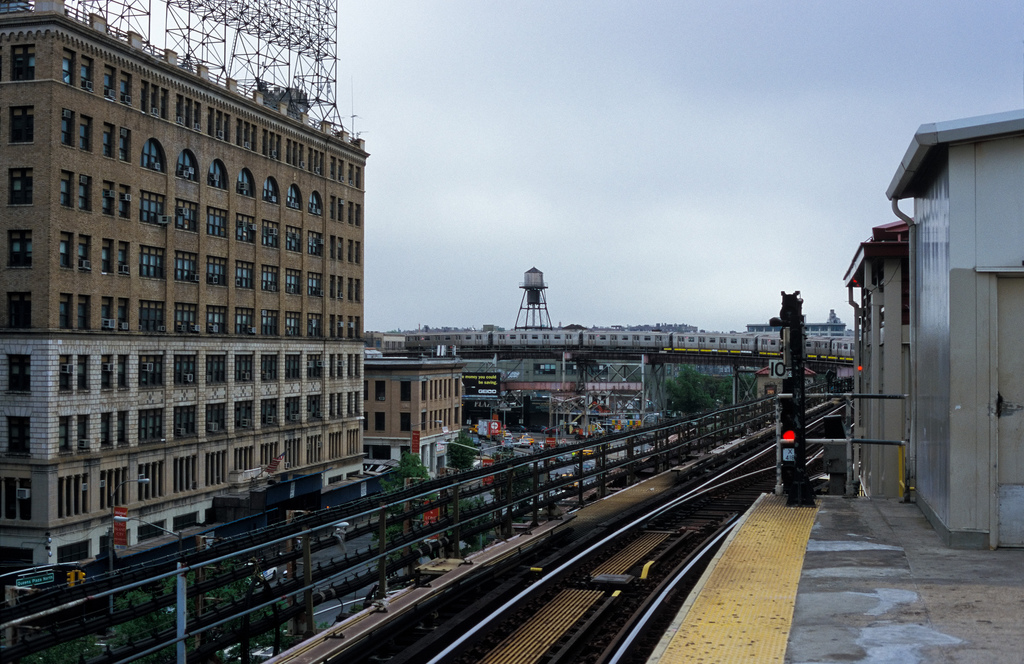
Welcome to Long Island City

Coming soon...

Spires and stacks

(This is the kind of day, back in May 1978, when Joe Savino
and I were walking along Northern Blvd., before we'd
stopped at a diner at 36th Street, the day we heard the
news from his cousin that their grandmother had died.
We were out of work at the time, and were searching
the neighborhood factories for possible jobs; miserable
responses, questions falling upon deaf ears.  At 6:30 a.m., we
knew that something terrible had happened.  When
we got back to the apartment in Jackson Heights,
Joseph Centrone telephoned and gave
 us the news about our beloved Benedetta Savino.)


N train


From page 8 of the book:  "...Owen had asked me to meet him in Long Island City, at a diner near 36th Street on Northern Boulevard.  Like I said, I wasn't in the habit of meeting people anywhere before sunrise, but his summons had had an affliction to it, an exhaustion.  With the blue shadows of dawn and the somnambulists dotting the streets of this warehouse district, I met Owen on a corner of the boulevard which was spotted with a pack of junked cars."


(The above photos of Long Island City are courtesy of npzo on Flickr.  Used with permision.)

Monday, December 27, 2010

Page 127 "Orwell scares me."


[George Orwell (1903-1950) was an English author and journalist. His work is marked by keen intelligence and wit, a profound awareness of social injustice, an intense, revolutionary opposition to totalitarianism, a passion for clarity in language and a belief in democratic socialism.  Orwell wrote fiction, polemical journalism, literary criticism and poetry and is best known for the dystopian novel Nineteen Eighty-Four and the satirical novella Animal Farm. They have together sold more copies than any two books by any other 20th-century author. His Homage to Catalonia, an account of his experiences as a volunteer on the Republican side during the Spanish Civil War, together with his numerous essays on politics, literature, language and culture, are widely acclaimed.  Orwell's influence on contemporary culture, popular and political, continues. Several of his neologisms, along with the term Orwellian, now a byword for any draconian or manipulative social phenomenon or concept inimical to a free society, have entered the vernacular.]


     From page 127 of the book:  "...Sarah was already charmed during the course of the evening. This latest compliment put her over the edge. She was completely in Ebert's hands. I still had reservations, since most of the conversation centered around our immediate past and what precipitated our emigration to France. Then there was talk of writing, of the many authors Ebert had met and known over the course of many decades. His fondest memory was that of knowing George Orwell for a brief period of time.
    "Orwell scares me," Owen admitted.
    "Well, Orwell saw the hard truth, and it wasn't a vision that he sentimentalized, I'll have you know."
    "That's why he scares me," said Owen.
    "That's why it's the hard truth," replied Ebert. "Later, during the Fifties, my own intimate circle in Paris denounced him as a mediocre talent, or a highbrow personality. What did they know?! The Left Bank. I liked him. I thought he was right. And I broke ranks with mes frères Parisiens. Snobs. I don't think you'd characterize any of his books as exciting."
    He puffed out some smoke and stared at the table.
    "Certainly Keep the Aspidistra Flying is sadly oppressive in its way."
He looked toward Sarah and me, as we weren't familiar with the novel, and then explained.
    "It was about a working-class fellow who wants to overcome his meager, penurious life. He wants to go beyond what everyone else will surely become; that is, a comfortable middle class life. Not a tragedy, but the truth."
    Ebert raised his eyebrows and looked at me.
    "Not a tragedy, but the truth," Owen echoed. "I'll drink to that.""


Page 124 "The Adventure of the Solitary Cyclist"


Arthur Conan Doyle


[Sir Arthur Conan Doyle (1859-1930) was a Scottish physician and writer, most noted for his stories about the detective Sherlock Holmes, which are generally considered a major innovation in the field of crime fiction, and for the adventures of Professor Challenger. He was a prolific writer whose other works include science fiction stories, historical novels, plays and romances, poetry, and nonfiction.]


     From page 124 of the book:  "...That day, the door to his room had been left ajar, as it would be during those baking, midwestern summer days, and I found him sitting at his desk reading. He was bathed in the bright sun streaming through venetian blinds, which in turn lit up the pale, cream-colored cinder block walls, providing a highlight of background against which he rested. His dark hair covered his ears, while his shoulders supported a grin which revealed two dimples. He hadn't the chance yet to furnish his room, so the emptiness of being newly arrived on campus was augmented by the room's hollow look. His book was opened to the first page of "The Adventure of the Solitary Cyclist," by Arthur Conan Doyle. How anyone could read in that late August heat was beyond me. How one could read Sherlock Holmes in that heat gave me pause for admiration."

                                                                                                                
The following link takes you to the full text of Conan Doyle's story: http://etext.virginia.edu/etcbin/toccer-new2?id=DoySoli.sgm&images=images/modeng&data=/texts/english/modeng/parsed&tag=public&part=all

This link takes you to IMDB's entry for the PBS TV series episode (this series is one of the best things ever to have appeared on television): http://www.imdb.com/title/tt0506456/


Page 123 "It's like the Yeats poem," he said.


William Butler Yeats
(photographed by G. C. Beresford)
 

From page 123 of the book: "...I looked up and away from where we stood, observing the lazy green countryside, searching for nothing in particular under that bright Sunday heat, when suddenly I spotted the brown suit Revenant had pointed out hanging from a window. Owen noticed it, too.
    "It's like the Yeats poem," he said. "'Fifteen apparitions have I seen; the worst a coat upon a coat hanger.'"
    "What do we do with that?" I asked.
    "It remains to be seen," he said tiredly.
    The Yeats poem gave me a shudder; as I remembered it from years past. Largely an old man's sensations about solitude and mysteries of the night, it was written in 1938, a year before the poet had died. Owen had originally read it to me during our freshman year at college in Peoria. It was my introduction to Yeats, an introduction that would bring on the rest of modern literature like a flood. Three months prior to hearing the poem, I'd entered his room for the first time. I'd gone in to say "hello.""


The Apparitions

William Butler Yeats

Because there is safety in derision
I talked about an apparition,
I took no trouble to convince,
Or seem plausible to a man of sense.
Distrustful of thar popular eye
Whether it be bold or sly.
Fifteen apparitions have I seen;
The worst a coat upon a coat-hanger.

I have found nothing half so good
As my long-planned half solitude,
Where I can sit up half the night
With some friend that has the wit
Not to allow his looks to tell
When I am unintelligible.
Fifteen apparitions have I seen;
The worst a coat upon a coat-hanger.

When a man grows old his joy
Grows more deep day after day,
His empty heart is full at length,
But he has need of all that strength
Because of the increasing Night
That opens her mystery and fright.
Fifteen apparitions have I seen;
The worst a coat upon a coat-hanger.

Page 110 "...symbols reminding one of John Dee"

From page 110 of the book:   "...I looked at my watch and, just realizing how late it was, and that I might be arrested for vagrancy or prowling (the French word for it was rôder; je rôde: I prowl, therefore I am). I wondered if I were going mad. I searched for the hallway to the front door and quietly let myself out.  

   After securing the front door, I stepped back a few feet to examine the rectory. The number thirteen was posted on the left. The windows, each divided into eighteen individual glass panes, were paired up with wooden shutters, which were in desperate need of paint and which were etched upon with symbols reminding one of John Dee. There was the archangel Uriel, holding his bronze disk marked with the symbols of the zodiac; there were crystals and bulls framed by the overgrowth of ivy. One in particular displayed the fish-entwined anchor of Jacopo Sannazaro. Vines of healthy, arcadian ivy grew up the sides of the house and around the windows, giving me the impression at first that they were closing in. On further inspection, I realized that the windows assumed personalities all their own; cajoling the ivy, inviting it, "Come in. Come in." I walked in the direction of la Fontaine and tried to restrain the presence of the metaphysical in my life."
                                                                   

(Clockwise from top left: Portrait of John Dee [artist unknown];
various occultic symbols associated with Dee.

[John Dee (1527-1608) was a noted English mathematician, astronomer, astrologer, occultist, navigator, imperialist,[4] and consultant to Queen Elizabeth I. He devoted much of his life to the study of alchemy, divination, and Hermetic philosophy.  Dee straddled the worlds of science and magic just as they were becoming distinguishable. One of the most learned men of his age, he had been invited to lecture on advanced algebra at the University of Paris while still in his early twenties. Dee was an ardent promoter of mathematics and a respected astronomer, as well as a leading expert in navigation, having trained many of those who would conduct England's voyages of discovery. In one of several tracts which Dee wrote in the 1580s encouraging British exploratory expeditions in search of the Northwest Passage, he appears to have coined (or at least introduced into print) the term "British Empire."]


Archangel Uriel (illustration courtesy of
Order of the White Lion)
["In all their affliction he was afflicted,
and the angel of his presence saved them:
in his love and in his pity he redeemed them;
and he bare them, and carried them
all the days of old." (Isaiah 63:9 King James Version)]

[In Christian apocryphal gospels, Uriel plays a role in the rescue of Jesus's cousin John the Baptist from the Massacre of the Innocents ordered by King Herod. He carries John and his mother Elizabeth to join the Holy Family after their Flight into Egypt. Uriel is often identified as a cherub and angel of repentance. He "stands at the Gate of Eden with a fiery sword," or as the angel who "watches over thunder and terror." In the Apocalypse of Peter he appears as the Angel of Repentance, who is graphically represented as being as pitiless as any demon. In the Life of Adam and Eve, Uriel is regarded as the spirit of the third chapter of Genesis. He is also identified as one of the angels who helped bury Adam and Abel in Paradise.]


Portrait of Jacopo Sannazaro by Titian, 1660
and his epigraph of a fish-entwined anchor

[Jacopo Sannazaro (1457-1530) was a poet whose work both in Latin and Italian was extremely fashionable in its own time. The court poet of King Ferdinand I of Naples, Sannazaro was a member and then leader of Pontano's humanist academy from the 1480s on.]

Saturday, December 18, 2010

Page 108 "..."John the Baptist?" he reflected, finishing his own brandy."


"Preaching of St John the Baptist" by Baciccio, 1690
From page 108 of the book:  "..."Fr. Revenent," I looked across the room, out of focus, out of color, "how did you know I was going to follow you?"
He sat up, gazed at the couch opposite him, facing the dormant fireplace and the two fragile, antique end-tables.  A leather hassock lay in front of his feet; I could tell that he rarely used it.
"I didn't know you would follow me," he said.  "It was a discovery that was as wonderful to me as it was to you."
We smiled together at his conclusion.  My eyes roved over indistinguishable shapes of pictures on the walls, as well as over two ceramic cherubim heads which hung near the doorway.  The unlighted figures of a fresco hailed from the last wall as I brought my perusal to a complete stop.  I sipped my brandy and winced from its strength.
"Who painted that thing?" I asked, trying to sound less like a critic and more like a friend.
 "John the Baptist?" he reflected, finishing his own brandy. "It was here when I arrived. Painted by a young art student, I'm told. He was eventually killed in Indochina, in October 1950. A certain General Carpentier had delivered his soldiers along Rout Coloniale 4, to retreat from a Viet Minh onslaught. My dear Walter, there were six thousand French troops lost; they just disappeared, in the jungle, without a trace."
It was the worst overseas defeat of the French since Wolfe beat Montcalm on the Plains of Abraham in Quebec, in 1759." 


Lambert Sustris, "Baptism of Christ"
(1591)


Gen. Carpentier


Route Coloniale 4 (RC4, also known as Highway 4) is a road in Vietnam, bordering the Chinese border from Hanoi to Cao Bang. It is famous for a French military disaster in 1950 in which several units of the French army, including some battalions of the Foreign Legion, were decimated by the Viet Minh and essentially ceased to exist as fighting units.


Rout Coloniale 4


French troops in Vietnam, circa 1950


Along the Rout Coloniale 4


Map showing whereabouts of Rout Coloniale 4

The Battle of Quebec (aka The Battle of the Plains of Abraham), September 13, 1759

Essentially the outcome of this battle, the military defeat of the French forces, represented a transfer of colonial power from one European country to another. The British ejected the French elite, installed their own, and picked up the colonial project where the French had left off. The remaining French-speakers were relegated to second class citizenship, and the First Nations were not consulted at all, despite the fact that this is their ancient territory. Despite francophone re-empowerment following the Quiet Revolution, the Plains of Abraham battle is still a touchy subject because it signifies domination over French-speakers by the British and later on Canadian governments.

French General Montcalm
 
British General Wolf


Postcard showing Quebec City. The yellow line and
dot points to the Plains of Abraham

Page 99 "...Albert Camus was buried there,..."

From page 99 of the book:  "...The driver spoke English and was grateful for Owen's request to stop at the cemetery in Lourmarin on the way to Gordes.  Albert Camus was buried there and Owen felt it would be a disgrace not to pay his respects to the man he referred to as the conscience of the 20th century."


This picture is known as "the famous pose of Albert Camus."


Camus' grave in Lourmarin.