Monday, August 1, 2011

Orhan Pamuk says...

"A writer is someone who spends years patiently trying to discover the second being inside him, and the world that makes him who he is: when I speak of writing, what comes first to my mind is not a novel, a poem, or literary tradition, it is a person who shuts himself up in a room, sits down at a table, and alone, turns inward; amid its shadows, he builds a new world with words." (Orhan Pamuk)


"He can write poems, plays, or novels, as I do. All these differences come after the crucial task of sitting down at the table and patiently turning inwards. To write is to turn this inward gaze into words, to study the world into which that person passes when he retires into himself, and to do so with patience, obstinacy, and joy." (Orhan Pamuk) 


One of my new "pages" on this blog is devoted to the deep admiration and respect I have for the Turkish novelist Orhan Pamuk.  His work enlightens, empowers, and entertains; and as a great man once said to me, "you can't get much better than that."  The page is titled simply, "Orhan Pamuk says..."

Saturday, July 9, 2011

New short story added to blog


I just added a new short story to my blog, if anyone's interested.
It's called, "Dear Lou, Please Kill the Cats."  
So, enjoy.

Monday, June 20, 2011

Page 306: "My lessons on the Provencals were never-ending."

From page 306 of the book:  My lessons on the Provençals were never-ending.  I remembered our second dinner with Ebert, where he'd explained that Alphonse Daudet was one of many great Frenchmen to have come from this region, and like many of those great Frenchmen he had referred to his birthplace, a land dominated by the industrial and wealthy North, as if it were a joke.  Daudet later explained, and one was supposed to believe it, that his mockery was merely a ruse for his true love of the South. 


Young Alphonse Daudet


cover of "Letters from My Mill"


Another edition of "Letters from My [Wind]Mill"


Alphonse Daudet


The Windmill


Plaque with Daudet quote which explains that, in this corner of the world, it was for him a fatherland where one could find beings or places in all of his books.  I know such a reverence.  I have four such corners: Connecticut, Illinois, Queens NY, and Arlington, VA. 

Page 326 "Duncan is in his grave"


From page 326 of the book:  I took de Chambrun's diary out of the envelope.... The following pages mentioned Lincoln reciting a passage from MacBeth, act three, scene four; I could only remember a small bit of it: "Duncan is in his grave; After life's fitful fever he sleeps well; ...nothing can touch him further."


Above: Three witches, from a stage production of "Macbeth"; Orson Welles as Macbeth; play edition cover.

Better be with the dead,
Whom we, to gain our peace, have sent to peace,
Than on the torture of the mind to lie
In restless ecstasy. Duncan is in his grave;
After life's fitful fever he sleeps well;
Treason has done his worst: nor steel, nor poison,
Malice domestic, foreign levy, nothing,
Can touch him further.
(Macbeth, Act III, Sc. 4)

Saturday, June 18, 2011

Page 366 "Still a sacrifice. Still a misunderstood man."


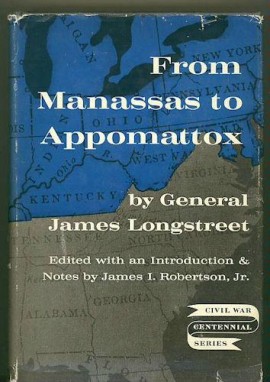
From page 366 of the book:  "You know, Walt," Owen expelled, resting his head against the back of the seat, turning to me at selected intervals between looking at the roof or out into the winter gloom. "After the Civil War was over, James Longstreet realized that there was no way to make the postwar South work unless somebody gave of themselves, to work within the system, to reconstruct the South, you know. When he became a Republican, and don't forget now the Republican Party was the party of the North, he'd offered himself as that sacrifice to the Cause. He sacrificed himself, going against his Southern brethren because he believed that getting placed into key Republican positions would actually help to rebuild the burned out and bombed out homes and cities of Dixie. He felt he could help the South by working to reunite it with the North in spirit. They hated him for it. They crucified him for it! They fucking rewrote history for it. Still a sacrifice. Still a misunderstood man."


James Longstreet

Page 318 "...and plucked from a small pile of books...Malraux's History of France"

From page 318 of the book:  He's reading Ebert's book, I thought, and I slumped onto my bed, and plucked from a small pile of books on my window sill Malraux's History of France. My eyes glued themselves to a chapter on Louis XIV, and how "The Monarchy's Greatness Prepared the Way for Its Downfall," and Owen's eyes were glued to a small section of Ebert's The Journal of Josef S.
Note:  In this excerpt, there is a typo.  It is not Andre Malraux's History of France, but A History of France by Andre Maurois, published in 1948.  Sometimes the typist in me segments from the writer.  I apologize for the mistake. --M.Z.


"If you create an act, you create a habit. If you create a habit, you create a character. If you create a character, you create a destiny.” [A.M.]

Andre Maurois


Monday, June 13, 2011

Sir Thomas Browne - from whose work I got the title of the novel

Sir Thomas Browne
(From whose work the title of my book comes.)

Sir Thomas Browne (1605-1682) was an English author of varied works which reveal his wide learning in diverse fields including medicine, religion, science and the esoteric.  Browne's writings display a deep curiosity towards the natural world, influenced by the scientific revolution of Baconian enquiry, while his Christian faith exuded tolerance and goodwill towards humanity in an often intolerant era. A consummate literary craftsman, Browne's works are permeated by frequent reference to Classical and Biblical sources and to his own highly idiosyncratic personality. His literary style varies according to genre resulting in a rich, unusual prose that ranges from rough notebook observations to the highest baroque eloquence. Although he was described as suffering from melancholia, Browne's writings are also characterised by wit and subtle humour.  (Text courtesy of Wikipedia)


Browne's Hydriotaphia
(photo courtesy of Kevin Faulkner)

For further reading, I recommend this site: Aquarium of Vulcan


The works of Sir Thomas Browne have had and continue to have a profound impact on my writing and on my thinking.  As we all know, it is not uncommon for writers to title their works from a sentence or a phrase or a whisper from the great works of literature. Several writers have given their books titles from the texts of Sir Thomas Browne, as I have.