Monday, December 26, 2011

Orhan Pamuk says #3: "Lost his taste for coffee, he also lost his mind."

Shah Tahmasp
"...the Persian Shah Tahmasp, who was the archenemy of the Ottomans, as well as the world's greatest patron-king of the art of painting, began to grow senile and lost his enthusiasm for wine, music, poetry, and painting: furthermore, he quit drinking coffee, and naturally, his brain stopped working. 


"One day when he had grown even older, he was possessed by a jinn, had a nervous fit and, begging God's forgiveness, completely swore off wine, handsome young boys, and painting, which is proof enough that after this great shah lost his taste for coffee, he also lost his mind."
A jinn


Text: Pamuk, Orhan.  My Name Is Red, Translated from the Turkish by Erdag M. Goknar, New York: Vintage Books, 2001, pp. 47-48.

Thursday, October 20, 2011

Page 117: If you know, Elijah, why do you pursue me?

 From page 117 of the book:  It spoke back to me:  'If you know, Elijah, why do you pursue me?'  The voice was deep, very bass.  It sounded electric, like it was speaking through impulses, you know, electrical impulses, or bees and mosquitoes that are on fire.  There was a lot of humming going on."
            Sarah shivered with disgust.
            "'I'm not Elijah,' I replied," continued Revenant.  "'You managed to keep yourself well, Elijah,' it said to me.  I told him again my name wasn't Elijah.  I don't appreciate being called a prophet.  'Why are you bothering me now?' it asked.  'Am I your fountain?  Must you drink again so soon, Elijah?' Well, my friends, I was confused.  Then he went down the stairs and rummaged in my cellar."


Elijah fed by an angel
painting by Ferdinand Bol, 1600-1663

"I followed him and chased him around some cardboard boxes, my bookshelves, around corners and pillars.  It was a race.  I wasn't up for a race, but I was always riding on the shadow of the light, never seeing its source.  Then," he stopped and sipped from his glass and caught his breath.  "Suddenly it stopped.  I said to it, 'I'm not here to ask you for anything.'  I could see the tail of the light from where I stood.  'I'm not a beggar!' I shouted.  'And besides, you woke me up!' I called to it.  'You weren't asleep,' it said.  He was right, of course," Revenant looked at me and smiled.  "I wasn't asleep.  'Well,' I said, 'I was going to.  Why won't you let me see you?' I asked.  There was no response from it.  'You hold it against me for the way I save souls, don't you?' I asked.  Still there was no answer from the light.  'Well?' I said.  Then the light vibrated, like fast breathing, you know.  'I'm aware that you don't want another Messiah,' I said.  'God knows we've had enough.  We get rid of them, don't we, fast, vite, like always?'

Then the light moved away from where it was and whirled past my back and flew up the goddam stairs.  As I reached the top stair, because I was goddammed if I was staying in the cellar, the light exploded.  It was so bright that it blinded me."


Page 116: The light moved like a thief would, you know, from one point to another.

From page 116 of the book:
"I was about to tell Owen and Sarah of a vision I had last night," said Revenant.  "I wonder seriously if it was, in fact, not another vision but real."
             Before I could fill a glass with wine, before I could fill a plate with cheese and a slice of bread with garlic and parsley, I had to ascertain how the hell Fr. Revenant came to be sitting in my living room, before I could tell Owen and Sarah how I met the priest, before the chance that Owen would have to explain to me how he met him.
            "Just be quiet and eat, will you?" Owen said to me, tossing more shells at the fireplace.
            According to Fr. Revenant, as he had passed the door to his spare bedroom, he'd heard an unrecognizable thump on the stairs leading to the first floor.  He hurried to the top of the stairwell and followed the diminishing traces of a radiant, blinding light moving from the living room and into the kitchen.


"'Who are you?  What are you doing here?' I heard the voice say," related Revenant in an excited voice.  "The light moved like a thief would, you know, from one point to another.  Then it stopped.  I ran down the stairs, spilling my brandy.  I cursed and then I followed the light wherever it went.  It left the kitchen and opened the cellar door and stayed just inside the staircase, waiting for me."


[Top photo courtesy of Chasing Light music band.]

Saturday, September 17, 2011

John Cowper Powys Championship Page - Post #5 - An Appreciation: Essay on Wolf Solent from "The Lectern"

The following essay is from a website called "The Lectern." I am indebted to the author, who refers to himself simply as Murr, for allowing me to reproduce his erudite and insightful literary excursion through one of the most brilliant and beautiful books of the 20th century--John Cowper Powys' "Wolf Solent." You can access his website by clicking here. I hope you enjoy it.

"Wolf Solent" John Cowper Powys


He had come more and more to regard 'reality' as a mere name given to the most lasting and most vivid among all the various impressions of life which each individual experiences. ... One of his own most permanent impressions had always been of the nature of an extreme dualism in which every living thing was compelled to take part.


Nomos and physis


This book operates on two distinct levels. The first level is a Lawrentian story of adultery and cuckoldry in a small English country town. Wolf Solent arrives in the town where he was born, after an absence of many years, to take up the post of secretary to the local squire. He falls in love with and marries Gerda, the daughter of the local stonemason. At the same time, he develops an ineluctable passion for the daughter of the local bookseller, Christie. His young wife is carrying on an affair with her childhood sweetheart, while Christie is fighting off the incestuous advances of her own father. Meanwhile, the squire is feuding with the vicar, and both are feuding with the local poet. There is lots of social observation, village fetes, afternoon tea, walks down leafy lanes, and a wealth of eccentric and eccentrically named characters. The novel is focalised through the eponymous protagonist, a highly educated, morbidly sensitive young man, the possessor of a 'mythology', and the story is largely about how he loses this personal mythology and becomes socialised in the world, a Dostoevskyan tale of how a young ego grows up and comes to terms with the disillusionment consequent on greater maturity and experience.


The second level, however, is really about something much deeper: man's relationship to nature, and the tension between human culture and society, and the natural world and its cyclical processes. On his journey to his hometown, Solent reflects on religion: ...It seemed as though all the religions in the world were nothing but so many creaking and splashing barges, whereon the souls of men ferried themselves over those lakes of primal silence, disturbing the swaying water-plants that grew there and driving away shy water fowl. Here, human culture, symbolised by religion, symbolised by creaking barges, floats on top of the primal lake of nature, barely disturbing it, but leaving no real lasting impact or impression. The book is really about the age old tension between nomos (society) and physis (nature), a tension first articulated by the Greeks.


The tension between these two, nomos and physis, is presented in two ways: by Solent's thoughts, and by the narrative voice, including plot and description.


Solent's Thoughts

Solent, as an educated man, sees the world in terms of Greek mythology. At times of stress he utters the Greek lament: Ailinon, Ailinon (Woe!) from Aeschylus, and he is aware of nymphs, dryads and other mythical creatures lurking in the undergrowth. Powys underpins all his novels with a mythical foundation, usually Arthurian or from the Mabinogion. Wolf Solent is unusual in using classical Greek mythology as a foundation, underlining further the nomos - physis dialogue.

Solent is acutely aware of nature, and of his position as a consciousness- endowed being in nature: nature was always prolific of signs and omens to his mind; and it had become a custom with him to keep a region of his intelligence alert and passive for a thousand whispers, hints, obscure intimations that came to him in this way. At key moments in the novel, he succumbs to reveries about nature and his position -as a representative of humanity- in nature. He has the ability, shared with the squire, to see things stripped of the mischief of custom. He constantly has flashes of intuition, in which the social world appears as superficial, and the natural world as the only reality: my world is essentially a manifold world. He exists in a kind of suspended state between cosmic immensity, and microscopic detail, a kind of Blakean vision of the whole world in a grain of sand. In the face of the primal silence of nature, the social conventional dilemma in which he finds himself - married to one woman but in love with another - appears meaningless and trivial, a creaking barge, merely the mischief of custom.

In a key passage, Solent engages in an imaginary dialogue with the skull of his dead father (the disembodied head is a key motif for Cowper Powys, and one that comes from the Mabinogion). Wolf asserts that reality is an illusion caused by consciousness, while his father asserts that the only reality is the natural world: "There is no reality but what the mind fashions out of itself. There is nothing but a mirror opposite a mirror, and a round crystal opposite a round crystal, and a sky in water opposite water in a sky, " asserts Wolf. "Ho! Ho! You worm of my folly," laughs the skull, "Life is beyond your mirrors and your waters. It's at the bottom of your pond, it's in the body of your sun, it's in the dust of your star spaces, it's in the eyes of weasels and the nose of rats and the pricks of nettles and the tongues of vipers and the spawn of frogs and the slime of snails."

Wolf believes that every human being is the possessor of a 'life illusion', a motivating force that underpins all interactions with the world and which defines the character of each person. To a certain extent, the novel is about how Wolf loses his 'life illusion' and ultimately sees that the real purpose of life is to forget and to enjoy, to endure and to escape, to surrender nomos in the face of physis. This takes place in the arena of a struggle between his mother, and his father. His mother represents nomos: What's the use of tilting against conventions? It's more amusing, it's more interesting, to play with these things. They're as real as anything else, she says. His father represents physis: "Life in me still, you worm of my folly, and girls' flesh is sweet for ever and ever; and honey is sticky and tears are salt, and yellow hammers' eggs have mischievous crooked scrawls."

The Narrative Voice

In the plot, the nomos - physis tension exists, as we have seen, in the social conventions of Wolf's marriage and the various adulteries surrounding it, and how these conventions appear when set against the natural world of physical love and procreation. Another key area in which this tension exists is in sex.

Nomos sanctions certain kinds of sexuality, and outlaws others, while physis has no attitude at all towards them. From the point of view of physis, all kinds of sexuality are natural, and sexual identity is seen as much more complicated than a mere hetero-homo duality. Nothing is against nature. That's the mistake people make, and it causes endless unhappiness. The minor characters all embody different kinds of sexuality: the bookseller Malakite and his two daughters embody incest; Wolf's own father, a promiscuous but now dead figure, embodies rampant heterosexuality uncomplicated by convention; the squire's obsession with Wolf's predecessor, the young man Redfern, represents a suppressed necrophilia; there are various homosexual relationships suggested between the vicar and the local poet, and Wolf himself is aroused by the sight of two village youths swimming naked in the local pond. One of these youths is his wife's lover, and Wolf is fascinated by the sight of the young man's genitals floating on the surface of the pond. His jealousy is tinged with envy. Celibacy is represented by the hideously ugly spinster Selena Gault who nurtures an undying but unreciprocated passion for Wolf's father; conventionalised sexuality is represented by Wolf's mother. Considering the book appeared in 1929, Cowper Powys was way ahead of his time both in his ideas about sexuality and in his depiction of it.

The book balances descriptions of social life with nature, and it is in these last that the enduring power of the book lies. No other prose writer in the language comes close to the power of Cowper Powys's writing on nature. His prose descriptions of the natural world can best be compared with the nature poetry of John Clare, Blake and Dylan Thomas. Cowper Powys can take us in one sentence from the furthest reaches of cosmic space to a drop of water on a frog's back.

His writing has an intensity of vision that lingers in the mind long after the book has ended, and which enhances the way we view our surroundings. If greatness in art is measured by its ability to rattle us, to change the very way we perceive the world, this book is very great art indeed.

My 'I am I' is no hard, small crystal inside me, but a cloudy, a vapour, a mist, a smoke hovering round my skull, hovering around my spine, my arms, my legs. That's what I am, a vegetable animal wrapped in a mental cloud, and with the will-power to project this cloud into the consciousness of others.

Tuesday, September 13, 2011

John Cowper Powys Championship Page: Redux Post #4 "He was drenched through and through with darkness and with peace."

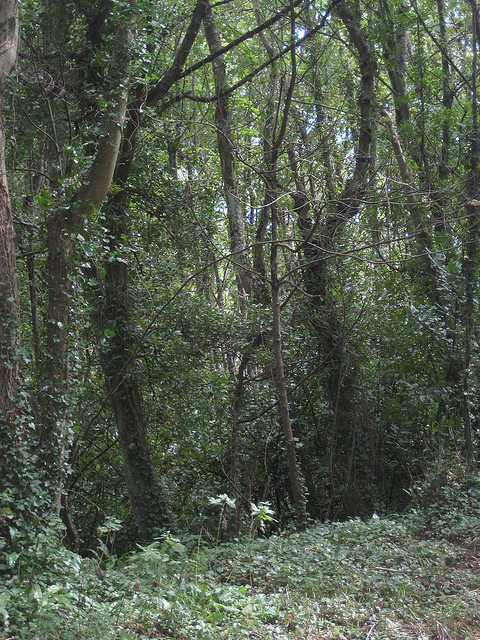
It was as though he had suddenly emerged, by some hidden doorway, into a world entirely composed of vast, cool, silent-growing vegetation, a world where no men, no beasts, no birds, broke the mossy stillness; a world of sap and moisture and drooping ferns; a world of leaves that fell and fell forever, leaf upon leaf;


a world where that which slowly mounted upwards endured eternally the eternal lapse of that which slowly settled downwards; a world that itself was slowly settling down, leaf upon leaf, grass-blade upon grass-blade, towards some cool, wet, dark, unutterable dimension in the secret heart of silence!


Lying upon that rank, drenched grass, he drew a deep sigh of obliterating release. ...Ah! how his human consciousness sank down into that with which all terrestrial consciousness began!...


He was a leaf among leaves...among large, cool, untroubled leaves.... He had fallen back into the womb of his real mother... He was drenched through and through with darkness and with peace.


(From John Cowper Powys, Wolf Solent, Chapter 18, "The School Treat")

Thursday, September 1, 2011

John Cowper Powys Championship Page: Post #3 "What came over the mind of the heretic priest at that moment was a certain day, years and years ago..."

(During the 1980s, after Wolf Solent, Weymouth Sands, and the Autobiography, I then read Ducdame.  I followed that with Maiden Castle.  I felt that I had gone over to another world, no mirror needed, no low door in the wall, but merely the further opening of my mind to a literature and a mythology that was bigger than anything I'd ever read before.) 


"What came over the mind of the heretic priest at that moment was a certain day, years and years ago, when, in the wretched playground of a second-rate preparatory school, he had watched a couple of his companions throwing handfuls of cinders taken from a galvanized iron ash bin at the body of a dead rat.  He had been the laughing stock of the school even before that day for his inability to conform to their standards, but after that day his loathing for every aspect of youthful high spirits hardened into a misanthropic mania." (p. 198)


"Netta pressed instinctively closer to the clergyman's side; for the figure that followed the voice, from what seemed the very depths of a watery ditch, was strange enough to scare the most preoccupied
mind.  It was that of a woman so old as to be almost beyond human recognition.  Her face was not so much the colour of ashes as the colour of the inside of a white eggshell that has been exposed on
the top of a rubbish heap for many weeks.  Out of this face looked forth a pair of ghastly sunken eyes, colourless now in the darkness, but possessed of some kind of demonic vitality that made both Hastings and Netta shrink and draw back, as if from the presence of something malignant and dangerous.
    "'Betsy must have known 'ee was coming dearie!  What else was I nursing my old bones for on way home from town?  'Twas so when the gentleman from London brought his sweetheart this way fifteen years agone.  These things be writ in the stars, sweet lady; they be writ in the stars.'"  (P. 201)
"Between his soul and all this enchanted spaciousness there arose a reciprocity he could not analyze, a feeling that had the irresponsibility of despair and yet was not despair, that resembled loneliness and yet was not loneliness.  It was almost as if, just behind all this etherealized chemistry, there really did exist something corresponding to the old Platonic idea of a universe composed of mind-stuff, of mind-forms, rarer and more beautiful than the visible world."  (p. 3)


(Glimpses of the Dorset countryside in which the novel Ducdame takes place.)


"The red coals in Lexie's grate seemed to lose something of their power.  The rosy glow reflected from Lexie's crowded bookcases seemed to fade.  The little blue fire devil that danced like a demon butterfly on the top of the colas flagged and drooped.  A great blind streaming face was pressed against the window--the gray featureless face of the rain.  It was as if a corpse-cold cloudy arm, wavering and shadowy, fumbled and plucked at those two dripping figures; as though, drenched as they were, they belonged to the drowning fields outside and not to this warm human interior."
(p. 31)

[All selections from Ducdame are courtesy of the Village Press edition, London, 1974.  First published by Doubleday, Page & Co., New York, 1925.]

Tuesday, August 30, 2011

Remembering William Goyen (1915-1983)

On this day in 1983, when my friends and I were living in Arlington, Virginia, almost a full year after having moved there from New York, William Goyen's death became known to us. 

Years before, when we were still living in Jackson Heights, N.Y., it was Joe Savino who'd read about him in Book Forum, from an article by Erika Duncan, and he immediately got a copy of The House of Breath, and read it straight through.  He then asked everyone he knew to read it.   In 1978, Joe and I wrote him a fan letter and this was his response:


Los Angeles
September 27, 1978
Dear Joseph Savino and Mark Zipoli:

I feel bad about the long silence between your wonderful letter (4/18/1978) and mine of right now, September 27, 1978, written from my bed upon which I lie in temperature (the weather's not mine) that has ranged during the last five days between 102 and 107, recovering from unexpected surgery three weeks ago and beginning to feel my good strength again.

I am not often here, since my wife is an actress working in films and television though I do not much care for the place and prefer my own apartment (i.e., my family's and mine) and workroom in New York. And I am here, because of my illness, when I had expected to be back in New York (where I shall return, doctor willing, in early November).

By now you have weathered five months in your new life and under your beautiful new commitment you wrote to me about.* I hope you are still there; I am sure that you are; I pray that you are. Give it some more months, my friends. Writing is a lifetime's work and I have always seen it as that. It was just what I was going to do for the length of my life, no matter how cruelly it treated me, how "unsuccessful" I was, who tried to talk me out of it, counsel me about it, warn me, disparage me. I was no martyr or saint--though in memory it seems I sometimes took the stance of those (now I see, at those times when I was most afraid). I stayed away-in deserts, on mountains, in Pensions, back street bed-sitting rooms. It was the staying away that I think about now as I'm writing to you; staying away, more than hiding out or escaping. I see that I had to do this to stay with what I was writing, which took the life out of most everything else except Nature itself, took the life out of love affairs, family building, owning things, insurance, and so forth.

Did I stay away when I should have been there? And those times when I was there, my God should I have stayed away? Well, I wrote and still do, lived as a man writing, and still do. The lifetime goes on, piling up memory and feeling, which is what I go on writing about. Simplicity helped. Can one live a life of simplicity now? More than ever I fight for it. Basic daily living, a day at a time. Living in many places (while staying away). Not getting bound. Keep the senses clean, and out of the head. Whitman (I'm reading him again right now) wrote "If the body is not the soul, then what is the soul?" Feeling and trying to keep feeling true, not to fuck up feeling, trying to write from true feeling, working to get that and to find true words for it. And telling people when you care, as you do me.

I'm so glad you wrote me what you did. If you're still there--and I know you are--send me a note to let me know. Forgive my silence. God speed!

Sincerely
William Goyen

(*) In the early spring of 1978, both Joe Savino and myself had quit our jobs to pursue writing.


Who was William Goyen?  As a writer, William Goyen strove to combine spiritual inquiry about the nature of man with the elements of humble daily life. His early childhood left his writing marked by the rhythms of rural speech, the Bible, and a sense of story. His father was a lumber salesman, and nearly all of Goyen's fiction is permeated with the atmosphere of the East Texas woods and small towns. His absorption with European writers did nothing to lessen his occupation with the details of the East Texas of his youth and the nuances of its speech. This attentiveness gives a strong regional flavor to those works in which Goyen attempts to recapture the atmosphere of life in East Texas during the twenties and thirties. His work has been an example to other writers who have sought to make use of the Texas past and has encouraged those whose artistry is not always appreciated in their native places. Though he left Texas early, Goyen owes more artistically to Texas than to New York and Europe, a debt that he frequently acknowledged.
     William Goyen, the son of Charles & Mary Goyen, was born at Trinity, Texas, on April 24, 1915. He moved with his [family] to Houston when he was eight, and there he grew up and attended public schools and what is now Rice University. After teaching at the U. of Houston in 1939–40, he enlisted in the U.S. Navy. He was discharged 4½ years later and never returned to Texas. Between 1945 and 1952 he lived in New Mexico, California, Oregon, Europe, & New York. After a stay in Taos, N.M., 1952-1954, he lived principally in New York.
     Goyen's first novel, The House of Breath (1950), and first book of short stories, Ghost and Flesh (1952), received much acclaim and won him two Guggenheim fellowships. His work was translated into German and French by Ernst Robert Curtius and Maurice Coindreau, and was soon established in Europe, where it remains in print in several languages. In the early 1950s, in addition to publishing another novel (In a Farther Country, 1955) and more short stories (The Faces of Blood Kindred, 1960), Goyen began to write dramatic works and adaptations of his fiction for the stage. The theater brought him into contact with actress Doris Roberts, whom he married in 1963.

     Over later years Goyen taught as a visiting professor at Brown, Columbia, Princeton, the University of Southern California, [among others and worked] as an editor at McGraw-Hill, 1966-71. He published A Book of Jesus in 1973, another novel, Come, The Restorer (1974), and his Collected Stories (1975). In 1977 he received the Distinguished Alumnus Award from Rice University. He moved to Los Angeles in 1975 and lived there (and in New York City) most of the rest of his life. He died in Los Angeles on August 30, 1983. (The work of his last years included an unfinished autobiography, short stories (collected posthumously), and a novel, Arcadio, published a few weeks after his death.)]


Biographical and critical text: Reginald Gibbons, "GOYEN, CHARLES WILLIAM," Handbook of Texas Online (http://www.tshaonline.org/handbook/online/articles/fgo32). Published by the Texas State Historical Association.