Monday, January 9, 2012

I believe the war is being deliberately prolonged by those who have the power to end it.


"I am making this statement as an act of wilful defiance of military authority, because I believe the war is being deliberately prolonged by those who have the power to end it."  So begins Pat Barker's novel, Regeneration, with a letter from Siegfried Sassoon to the "Times" of London, July 1917.   A lot of parallels in Barker's novel of World War I to what's been going on in the U.S. and the world since before September 11.  We could stand to read books from and about WW I.  Might change our aggressive responses to anything and everything not American.
 Here are the fiction books I read during 2011.


The new year started with Thomas McGuane's Nobody's Angel (very funny) and James Salter's A Sport  and a Pastime.  Says Jesse Kornbluth of James Salter: "He’s considered a “writer’s writer” --- that is, too good for the masses to appreciate. There are worse things to be called. Still, to be a "writer's writer" for 35 years...."  These books are very different from each other. Both are extremes in the same world.  I liked them.  I recommend them.


In February it was more of McGuane, Driving on the Rim, and a short one from the Master, Henry James' Turn of the Screw.  I'm liking McGuane more each time I read him.


In March I read a good historical novel called Conspirata by Robert Harris, who gave us Pompeii, which I read in 2010, and liked very much.  Conspirata is the story of the plot to assassinate Julius Caesar.  You know me and gladiators, Romans, and aquaducts, just can't get enough.  Also read Colum McCann's Zoli, a very moving novel of a gypsy woman and her clan. I got lost in the time shifts, but the critics seemed to like it a lot.


Also read Jim Harrison's The English Major.  I tell you, I've read a lot of Harrison; and I wish my blog could be a brilliant and luminous billboard for the works and life of Jim Harrison.  I love his books.  His life-view is widesweeping, or widestretching or something wide, big, sprawling like Montana and Nebraska and Arizona.  He loves food and wine, and so do I.  He loves literature, and so do I.  I wish I started reading him years ago, but there's just so much a person can do.  I wish Harrison could get a postage stamp.  I wish more people would read him, especially people in power, in academia, or in hotels (instead of watching ESPN or "Two & a Half Men" and drinking expensive cocktails in the bar).

If March goes in like a lion and out like a lion, that's what it was like to read Henning Mankell's The Man From Beijing (a murder mystery of worldwide stature, brilliant, historical, well-written) and The Possibility of an Island from my man Michel Houelbecq.  Houelbecq has become my alter ego, without him knowing of course, and I've read The Elementary Particles and Platform, both of which have offended readers and critics, and I'm so glad. I've got my hands on his new book, The Map and the Territory, and can't wait to start it.

French novelist Michel Houelbecq


In June I read Vladimir Nabokov's Laughter in the Dark and Edward Abbey's The Monkey Wrench Gang.  Laughter in the Dark, I must admit, is not one of Nabokov's better books.  It contains his penchant for older man younger woman, very young woman, and I'm still to this day trying to figure out the "why" of the book.

  Edward Abbey's The Monkey Wrench Gang is a great book.  It is a book of movement, hilarity, drunkenness, saboutage, sex, the hot hot sun of the southwest, and I tell you, while I scratched my imaginary five o'clock shadow and squinted as I took a pull on the sixth beer I wasn't drinking, I loved every minute of it.

In July I read James Jones' Some Came Running, which I got at the Santa Monica Library's bookstore for $2.00.  I've been wanting to read it for a long time, and I was not disappointed, except for the irritation factor which Jones employs by not using apostrophes when he writes contractions, and then there's this style he likes of stating a noun in a sentence, and then in the same or next sentence using that noun's adverbial form, and then adverbially again, and again.  Mr. Jones it appears was not in the habit of listening to his editors.  (Sorry, that's just me being an effete intellectual snob.)  I liked the book and hope it continues to draw readers. 
Also in July I read The Easter Parade by Richard Yates. In August I read Pat Barker's World War I novel Regeneration, the first in the trilogy, with appearances by Siegfried Sassoon, Robert Graves, and Wilfred Owen. I really enjoyed this book and am looking forward to the next two.


Also in August I finally finished Naguib Mahfouz's Palace Walk, the first in the Cairo trilogy series.  It was a very long book, but it was also very good.  Mahfouz's expose of the male-dominant, male-hypocritical dominant culture of WW I Egypt, its occupation by the Allies, its Ottoman Empire backwardness, and its social customs that suppress women to the point of a scrap metal crusher can sometimes make for frustrating reading; but it is important to read him, I feel, it is very important. Mahfouz, winner of the Nobel Prize, was (toward the end of his life) shot by a would-be assassin's bullet, an Islamic fanatic who didn't like the author's parodies, to say it mildly.  But he continued.  Individuals with a voice for individual freedom and the freedom of others often get in the way of the violent swing of the moralist's hammer.  The characters in Palace Walk are very likeable, and the misfortune of living in an occupied country and being hamstrung by religious fundamentalism causes one [the reader] compassion, not condescension.  Christopher Dickey of Newsweek writes:

"Palace Walk, first published in 1956, is the best of Mahfouz's work. He drew heavily on autobiography (like the character Kamal, he was the youngest son in a large merchant clan). He writes about family, and to understand the Egyptian family is to understand, more clearly than any political treatise can explain, the soul of the country."

Egyptian novelist Naguib Mahfouz


Also read Anne Enright's The Gathering and Daniel Woodrell's Tomato Red.  Lots of anger and yelling in Enright's book, especially at a time of death; lots of anger and blame and melodramatic stuff that you need more than tea to swallow down as you read it.  Tomato Red however is a horse of a different color.  It's a very strange book, set in Ozark country, told in powerful prose with the strange leaking bizarreness of smaller than small-town life. I'll read more Woodrell for sure.  Then came Julian Barnes' Flaubert's Parrot.  This was more interesting (for its biographical sketchs of French novelist and national hero Gustav Flaubert and his contemporaries) than it was meaningful reading (as a novel).  I haven't given up on Barnes, so don't worry.  But Flaubert's Parrot I feel was written for the academic literati, and therefore not as clever and brilliant as everyone thinks.  But that's just me being an effete intellectual snob.

Vlad Dracul, the Impaler, Count Dracula
September found me reading Muriel Spark's The Only Problem, Elizabeth Kostova's The Historian, Long Last Happy by Barry Hannah, and Joseph O'Neill's Netherland.  Let's just say that I liked all three of these books.  Kostova's novel about the search for Vlad the Impaler remains fairly true to legend and revealed an immense amount of scholarship mixed with flashbacks and country-hopping.

  The Only Problem is unusual, "an extremely sophisticated account of the perils that surround our unsuspecting lives in the world today and a disputation on the subject of the Book of Job, which she calls 'the pivotal book of the Bible.'" [Anita Brookner, The New York Times]
Joseph O'Neill

 I liked Netherland more than I expected; lots of Brooklyn, shady immigrants, post-September 11 anxiety, and a troubled marriage.  I'm not doing the author justice (but I recommend it highly)  Netherland is the "story of a family. The narrator, Hans van den Broek, is a Dutch-born equities analyst who lives in a TriBeCa loft with his British-born wife, Rachel, and their son. When 9/11 forces them to flee uptown, they end up living...in the shabby-glamorous Chelsea Hotel, and it is there that their marriage slowly cracks apart.  The book’s second story line is about the solace Hans finds in the vibrant subculture of cricket in New York, where he is among the few white men to be found on the hundreds of largely West Indian teams in the city, teams that fan out, in the hazy summertime, across scrabby, lesser-known public parks." [Dwight Garner, The New York Times]

One of the most enjoyable and entertaining and empowering writers I read this year was the late Barry Hannah.  I kept quoting passages from these stories to my friends, laughing out loud while I did so; I could not get over how good this book is.  (Sorry about the tense variations within one sentence.) I can unconditionally say that, except for my friend Joe Savino, and perhaps the late Larry Brown, Barry Hannah's work was singular in its influence upon my short story writing efforts in 2011.  I haven't read a lot of Hannah's books, just a novel Yonder Stands Your Orphan and the collection of selected short stories featured at left, Long, Last, Happy, but in 2012 I'm going to. 

October was a busy month for reading, probably because like August and September, the six furlough days I had to take from work gave me down time and escape time.  Only negative there is escaping into literature isn't going to pay the bills.  Nevertheless, here's to October:  The Last Good Kiss by James Crumley; The Great Leader by Jim Harrison; On Beauty by Zadie Smith; and A Man of Parts by David Lodge.
Author photos:  James Crumley, David Lodge, H.G. Wells
The Last Good Kiss is not the kind of book I would have picked up in years gone by, unless it came highly recommended by someone I know.  But I tell you, this book is hilarious.  You've got the pervading presence of an alcoholic bulldog among a cast of whacked out other characters while our protagonist is trying to solve a mystery and trying to do so while intensely inebriated.  I loved this book.  A Man of Parts, another book by one of my favorite authors, David Lodge, this time about H.G. Wells.  Lodge also gave us Author Author about the Master, Henry James, so you can bet your bottom dollar he's aces in my book, and has been for many many years.  I have posted on the wall above my big chair, in which I read, some codes of narrative coherence that Lodge feels one should, as a writer, adhere to.   A Man of Parts gives one insight into H.G. Wells that quite frankly astounded me. And I'm not going to share them here either, you have to read the book.  Zadie Smith's On Beauty is a very good book; well-written, intelligent; her prose places the cheek of another human face close to your own skin to prove that we are not all that different.  Feel the warmth.
The Great Leader by my hero Jim Harrison is subtitled a faux mystery.  But it wasn't so; he followed the structure of a good mystery and entertained us (as he usually does) with his love of food and poetry and drink, and his love of the exquisite bottoms of young women; so many sexual meanderings to the point of well, damn, the book had to come to an end someplace.  Unfortunately.

November gave me Barbara Kingsolver's The Lacuna; Pete Dexter's Paris Trout; Sam Lipsyte's The Ask; and Jim Harrison's Warlock.  This was some month, aside from Thanksgiving.


 My friend Barbara Mock Autry and I, one fine spring evening in San Diego, shortly before she and her family moved East, were talking books and I brought up Kingsolver's The Poisonwood Bible, which she read and loved; "...then you have to read The Lacuna.  You will love it, Mark," she said, "I know you will." And I did.
Artists Frida Kahlo and Diego Rivera
The sections with Frida Kahlo and Diego Rivera were very entertaining, I enjoyed quoting them to my friends.  The historical points of reference concerning the Mexican communist party movement, the sanctuary given to Leon Trotsky by the Riveras, even though Trotsky's on Stalin's hit list, and the hypocrisy of American govenment and culture during the HUAC period, together with a young man's blossoming writing career based on his life with Frida and her bunch, all made for a wonderful book. And I haven't even explained the half of it.
Barbara Kingsolver
 I am a great fan of Barbara Kingsolver, to be sure.

 Paris Trout.  What can I say about the meanest sonofabitch I've come across in a long time, not since Larry Brown's character of the father in Joe.  Paris Trout is a true believer; he's also a despicable human being. This is a great book.  At times it was a nightmare.

  "Things look different ways when they ain't clear," Trout said.  "I don't forgive debts," he said.  "I pay my obligations, and I am paid in return.  ...you forgive one debt, ain't none of them going to pay you ever." 

The nastiness of Paris Trout sent me through the roof, especially when he declares, "I don't have a cruel heart."  Well, my friends, read the book.

I also read The Ask by Sam Lipsyte, which had some moments, I must admit.  And then Warlock by Jim Harrison, about an unemployed foundation executive whose life becomes unhinged.  I enjoyed this book very much.  It's Jim Harrison.


 In December it was McEwan's Black Dogs. This is a strange book, and McEwan often makes me uncomfortable, which is the pleasure I get from reading him. "The story revolves around a dramatic and terrifying event which changed the whole life of the narrator's mother-in-law, affecting her rather as Paul's vision on the Road to Damascus did him, although the experience was one of darkness, not of light. ...Black Dogs is curious and at times unpleasant. In the end, you can, as Bernard would, dismiss it as just a story, or, like June, you can look deeper and ponder the ideas further." [Courtesy of Ann Skea]
Muriel Spark's The Driver's Seat was crazy; a crazy Englishwoman in Rome. So far it's by my least favorite book from her.  Cross Channel by Julian Barnes is a collection of short stories about English people who have settled in northern France, and I'm talking Middle Ages, post-World War II, any time.  It's a pretty good collection. I'm looking forward to reading more of Barnes.


And that, as they say, is that.

Thursday, January 5, 2012

The will of Zeus was moving toward its end.

 "The will of Zeus was moving toward its end.  If ever I roofed a shrine to please your heart,...now bring my prayer to pass...your arrows for my tears!"
 
[The Iliad, Book I., Homer, translated by Robert Fagles.]


Such is a mere clip from Thomas Cahill's book, Sailing the Wine Dark Sea: Why the Greeks Matter. The book was the last I finished in the year 2011. 
 It was brilliant, and I have read Cahill before (How the Irish Saved Civilization and Mysteries of the Middle Ages), and I can tell you he brings history alive, he reanimates the atmosphere, the people, and in this book the very syntax of life from 2000 B.C. through the conquest of Greece by Philip of Macedon, and you will like it, because he makes it so.


Nonfiction Books Read During 2011

Retreating through the past year, I must say it's been a bitch of a year personally, financially, and occupationally, but what a grand time as far as books go! I've had a Great Reading Year, and beg your indulgence for allowing me to share it with you.  First I will tackle the nonfiction, and then in a subsequent post, I’ll do the fiction.

In January, there was Orhan Pamuk’s The Naïve and the Sentimental Novelist, and Home Town by Tracy Kidder.  Pamuk’s book was his collected lectures at Harvard, pieces of which I’ve excerpted here on this blog; and Kidder’s book was a heartwarming, charming story of a small town in Massachusetts told from the point of view of a policeman.  My uncle, Joseph Zipoli, was an admired and respected cop of some notoriety in my home town of Meriden, Connecticut.  I could surely see many of the plights and aggravations of small-town law enforcement mirrored in the pages of Kidder’s book and in the coffee-bruised sunken eyes of my uncle, and the toll it took on him and his family.

In February, it was the hilarious travel adventures recounted in Pico Iyer’s Video Night in Kathmandu.  This book, like Iyer’s others, is so filled with the comic moments and alien-dark bizarre life of our fellow earthlings, that I could not put the book down.  My favorite chapter was on Hong Kong.


Steven Rinella
 I read Steven Rinella’s American Buffalo in April, as well as The Tipping Point by Malcolm Gladwell, Operation Mincemeat by Ben MacIntyre, and Rinella’s other book The Scavenger's Guide to Haute Cuisine.  Rinella, as you may know, used to have a show on TV called "The Wild Within."  It was fascinating, entertaining, informative, and I highly recommend the whole opus when it comes to Rinella.


Operation Mincemeat: How a Dead Man and a Bizarre Plan Fooled the Nazis and Assured an Allied Victory, is more than an expansion of The Man Who Never Was; it is a brilliant exciting fact-filled and humorous account of that whole affair.  If you study WW2, you must read this book. Gladwell’s Tipping Point took me places that I was unprepared for; understanding how society moves and breathes, and telling it in such a fascinating way, anthropology never had it so good.


In May, my man Thomas Cahill thrilled me with Mysteries of the Middle Ages: The Rise of Feminism, Science, and Art from the Cults of Catholic Europe.  The Amazon.com blurb says it all: “On visits to the great cities of Europe—monumental Rome; the intellectually explosive Paris of Peter Abelard and Thomas Aquinas; the hotbed of scientific study that was Oxford; and the incomparable Florence of Dante and Giotto—Cahill brilliantly captures the spirit of experimentation, the colorful pageantry, and the passionate pursuit of knowledge that built the foundations for the modern world.”


June 2011 found me returning to Malcolm Gladwell with Blink: The Power of Thinking Without Thinking.  “Blink reveals that great decision makers aren't those who process the most information or spend the most time deliberating, but those who have perfected the art of "thin-slicing"-filtering the very few factors that matter from an overwhelming number of variables.”  So they say.


  I also read Mark Kurlansky’s Cod: A Biography of the Fish that Changed World, and indeed it did.  Excellent book.  And it has taken me 55 years to get over my dislike of fishy fish, like cod, and now I love it.


Musicophilia by Oliver Sacks and Packing for Mars by Mary Roach kept me busy in July. Musicophila was especially poignant for me since most mornings I wake up with amazingly stupid songs in my head and wonder if I’ve been abducted during the night and aliens played 1970s radio the whole time they were probing me.  Mary Roach’s book was funny, informative, and scary since she deals with the romantic aspirations of astronauts and uptight NASA officials.

In August it was Bill Bryson’s At Home: A Short History of Private Life.  I couldn’t believe how he wove what he did into a well-written, remarkable history of each and every room in your house. I love Bill Bryson. You can’t go wrong with any of his books. 


Outliers, by Malcolm Gladwell brought me into September.  This is what you’re getting into with his book:  “Outliers: The Story of Success examines the factors that contribute to high levels of success. ...[Gladwell] examines the causes of why the majority of Canadian ice hockey players are born in the first few months of the calendar year, how Microsoft cofounder Bill Gates achieved his extreme wealth, and how two people with exceptional intelligence end up with such vastly different fortunes.” We’re dealing with the "10,000-Hour Rule" and it is captivating reading. 

The Outlaw Sea by William Langewiesche was an eye-opening account of how little we know about how devastating the Sea can be, from pirates, to storms, to oil tankers falling apart, to well almost everything.  I think I’ll take a plane.

Hometowns, edited by the late John Preston, introduced October 2011.  In this book are collected essays by gay American authors who talk about growing up in their hometowns.  At times it was quite an emotional read, but I found that the overall affirmation was one of finding one’s niche in the world, and often in the most unlikely places.  I also read Douglas Waller’s Wild Bill Donovan: The Spymaster Who Created the OSS and Modern American Espionage.

  It was a good book, I liked Donovan more than I thought I would, even though he was often an unlikeable fellow.  One can’t deny his bravery or his belief in raising intelligence in the U.S. to an art form without the bigoted and infected mindset of people like J. Edgar Hoover, who is all over this book, insidious, backstabbing, lying.

In November it was Inside the KGB by Vladimir Kuzichkin, a former KGB officer (the name is a pseudonym).   Probably some of the most boring writing I’ve ever come across in espionage-related texts; however, the insights he provides into the workings of the Soviet Communist Party and its legion of operatives are unbelievable: the fact that the USSR lasted as long as it did is a miracle: Corruption, stupidity, incompetence, drunkenness, permeated the KGB and GRU to the point of absurdity.


December it was My Life in France by Julia Child; it is a lovely audio book; however, I would “read” it during my lunch hour, before I ate, and the constant descriptions of the food she cooked, the recipes, the ecstasy of her restaurant visits literally drove my stomach to exponential hunger pangs.

Julia Child

 Also read Barbara Kingsolver’s Animal, Vegetable, Miracle, in which she describes a year of life in western Virginia, and her family’s commitment to completely organic and locally grown foods and livestock.  It was amusing and very educational.

 Just Kids by Patti Smith was read by my entire household.  It is well-written, nostalgic, entertaining, and at times highly self-absorbed, which is for the most part what I thought of her and Robert Mapplethorpe’s photography.  It did not detract from their sweetness, nor did it impact my enjoyment of the book.
 Last Night I Dreamed of Peace is a posthumous memoir of Dang Thuy Tram, who was a field doctor for the North Vietnamese army, stationed in the central highlands, during 1968-1970.  It was quite a heart-breaking account of little more than two years (in journal entries).  The hardships and daily suffering that both civilians and soldiers endured while fighting a war of liberation is a moving storythat most people in this county know absolutely nothing about.  Sadly enough, I wonder if they will ever want to know.  Time does not heal all wounds.  Then came Sailing the Wine Dark Sea by Cahill and Falling Off the Map by Pico Iyer.  Iyer’s book focused on the Lonely Places on Earth.  His reportage of Paraguay and Iceland I read out loud to my friends, as it had me cracking up.

  More to follow, the fiction list, probably tomorrow.

Monday, December 26, 2011

Orhan Pamuk says #3: "Lost his taste for coffee, he also lost his mind."

Shah Tahmasp
"...the Persian Shah Tahmasp, who was the archenemy of the Ottomans, as well as the world's greatest patron-king of the art of painting, began to grow senile and lost his enthusiasm for wine, music, poetry, and painting: furthermore, he quit drinking coffee, and naturally, his brain stopped working. 


"One day when he had grown even older, he was possessed by a jinn, had a nervous fit and, begging God's forgiveness, completely swore off wine, handsome young boys, and painting, which is proof enough that after this great shah lost his taste for coffee, he also lost his mind."
A jinn


Text: Pamuk, Orhan.  My Name Is Red, Translated from the Turkish by Erdag M. Goknar, New York: Vintage Books, 2001, pp. 47-48.

Thursday, October 20, 2011

Page 117: If you know, Elijah, why do you pursue me?

 From page 117 of the book:  It spoke back to me:  'If you know, Elijah, why do you pursue me?'  The voice was deep, very bass.  It sounded electric, like it was speaking through impulses, you know, electrical impulses, or bees and mosquitoes that are on fire.  There was a lot of humming going on."
            Sarah shivered with disgust.
            "'I'm not Elijah,' I replied," continued Revenant.  "'You managed to keep yourself well, Elijah,' it said to me.  I told him again my name wasn't Elijah.  I don't appreciate being called a prophet.  'Why are you bothering me now?' it asked.  'Am I your fountain?  Must you drink again so soon, Elijah?' Well, my friends, I was confused.  Then he went down the stairs and rummaged in my cellar."


Elijah fed by an angel
painting by Ferdinand Bol, 1600-1663

"I followed him and chased him around some cardboard boxes, my bookshelves, around corners and pillars.  It was a race.  I wasn't up for a race, but I was always riding on the shadow of the light, never seeing its source.  Then," he stopped and sipped from his glass and caught his breath.  "Suddenly it stopped.  I said to it, 'I'm not here to ask you for anything.'  I could see the tail of the light from where I stood.  'I'm not a beggar!' I shouted.  'And besides, you woke me up!' I called to it.  'You weren't asleep,' it said.  He was right, of course," Revenant looked at me and smiled.  "I wasn't asleep.  'Well,' I said, 'I was going to.  Why won't you let me see you?' I asked.  There was no response from it.  'You hold it against me for the way I save souls, don't you?' I asked.  Still there was no answer from the light.  'Well?' I said.  Then the light vibrated, like fast breathing, you know.  'I'm aware that you don't want another Messiah,' I said.  'God knows we've had enough.  We get rid of them, don't we, fast, vite, like always?'

Then the light moved away from where it was and whirled past my back and flew up the goddam stairs.  As I reached the top stair, because I was goddammed if I was staying in the cellar, the light exploded.  It was so bright that it blinded me."


Page 116: The light moved like a thief would, you know, from one point to another.

From page 116 of the book:
"I was about to tell Owen and Sarah of a vision I had last night," said Revenant.  "I wonder seriously if it was, in fact, not another vision but real."
             Before I could fill a glass with wine, before I could fill a plate with cheese and a slice of bread with garlic and parsley, I had to ascertain how the hell Fr. Revenant came to be sitting in my living room, before I could tell Owen and Sarah how I met the priest, before the chance that Owen would have to explain to me how he met him.
            "Just be quiet and eat, will you?" Owen said to me, tossing more shells at the fireplace.
            According to Fr. Revenant, as he had passed the door to his spare bedroom, he'd heard an unrecognizable thump on the stairs leading to the first floor.  He hurried to the top of the stairwell and followed the diminishing traces of a radiant, blinding light moving from the living room and into the kitchen.


"'Who are you?  What are you doing here?' I heard the voice say," related Revenant in an excited voice.  "The light moved like a thief would, you know, from one point to another.  Then it stopped.  I ran down the stairs, spilling my brandy.  I cursed and then I followed the light wherever it went.  It left the kitchen and opened the cellar door and stayed just inside the staircase, waiting for me."


[Top photo courtesy of Chasing Light music band.]

Saturday, September 17, 2011

John Cowper Powys Championship Page - Post #5 - An Appreciation: Essay on Wolf Solent from "The Lectern"

The following essay is from a website called "The Lectern." I am indebted to the author, who refers to himself simply as Murr, for allowing me to reproduce his erudite and insightful literary excursion through one of the most brilliant and beautiful books of the 20th century--John Cowper Powys' "Wolf Solent." You can access his website by clicking here. I hope you enjoy it.

"Wolf Solent" John Cowper Powys


He had come more and more to regard 'reality' as a mere name given to the most lasting and most vivid among all the various impressions of life which each individual experiences. ... One of his own most permanent impressions had always been of the nature of an extreme dualism in which every living thing was compelled to take part.


Nomos and physis


This book operates on two distinct levels. The first level is a Lawrentian story of adultery and cuckoldry in a small English country town. Wolf Solent arrives in the town where he was born, after an absence of many years, to take up the post of secretary to the local squire. He falls in love with and marries Gerda, the daughter of the local stonemason. At the same time, he develops an ineluctable passion for the daughter of the local bookseller, Christie. His young wife is carrying on an affair with her childhood sweetheart, while Christie is fighting off the incestuous advances of her own father. Meanwhile, the squire is feuding with the vicar, and both are feuding with the local poet. There is lots of social observation, village fetes, afternoon tea, walks down leafy lanes, and a wealth of eccentric and eccentrically named characters. The novel is focalised through the eponymous protagonist, a highly educated, morbidly sensitive young man, the possessor of a 'mythology', and the story is largely about how he loses this personal mythology and becomes socialised in the world, a Dostoevskyan tale of how a young ego grows up and comes to terms with the disillusionment consequent on greater maturity and experience.


The second level, however, is really about something much deeper: man's relationship to nature, and the tension between human culture and society, and the natural world and its cyclical processes. On his journey to his hometown, Solent reflects on religion: ...It seemed as though all the religions in the world were nothing but so many creaking and splashing barges, whereon the souls of men ferried themselves over those lakes of primal silence, disturbing the swaying water-plants that grew there and driving away shy water fowl. Here, human culture, symbolised by religion, symbolised by creaking barges, floats on top of the primal lake of nature, barely disturbing it, but leaving no real lasting impact or impression. The book is really about the age old tension between nomos (society) and physis (nature), a tension first articulated by the Greeks.


The tension between these two, nomos and physis, is presented in two ways: by Solent's thoughts, and by the narrative voice, including plot and description.


Solent's Thoughts

Solent, as an educated man, sees the world in terms of Greek mythology. At times of stress he utters the Greek lament: Ailinon, Ailinon (Woe!) from Aeschylus, and he is aware of nymphs, dryads and other mythical creatures lurking in the undergrowth. Powys underpins all his novels with a mythical foundation, usually Arthurian or from the Mabinogion. Wolf Solent is unusual in using classical Greek mythology as a foundation, underlining further the nomos - physis dialogue.

Solent is acutely aware of nature, and of his position as a consciousness- endowed being in nature: nature was always prolific of signs and omens to his mind; and it had become a custom with him to keep a region of his intelligence alert and passive for a thousand whispers, hints, obscure intimations that came to him in this way. At key moments in the novel, he succumbs to reveries about nature and his position -as a representative of humanity- in nature. He has the ability, shared with the squire, to see things stripped of the mischief of custom. He constantly has flashes of intuition, in which the social world appears as superficial, and the natural world as the only reality: my world is essentially a manifold world. He exists in a kind of suspended state between cosmic immensity, and microscopic detail, a kind of Blakean vision of the whole world in a grain of sand. In the face of the primal silence of nature, the social conventional dilemma in which he finds himself - married to one woman but in love with another - appears meaningless and trivial, a creaking barge, merely the mischief of custom.

In a key passage, Solent engages in an imaginary dialogue with the skull of his dead father (the disembodied head is a key motif for Cowper Powys, and one that comes from the Mabinogion). Wolf asserts that reality is an illusion caused by consciousness, while his father asserts that the only reality is the natural world: "There is no reality but what the mind fashions out of itself. There is nothing but a mirror opposite a mirror, and a round crystal opposite a round crystal, and a sky in water opposite water in a sky, " asserts Wolf. "Ho! Ho! You worm of my folly," laughs the skull, "Life is beyond your mirrors and your waters. It's at the bottom of your pond, it's in the body of your sun, it's in the dust of your star spaces, it's in the eyes of weasels and the nose of rats and the pricks of nettles and the tongues of vipers and the spawn of frogs and the slime of snails."

Wolf believes that every human being is the possessor of a 'life illusion', a motivating force that underpins all interactions with the world and which defines the character of each person. To a certain extent, the novel is about how Wolf loses his 'life illusion' and ultimately sees that the real purpose of life is to forget and to enjoy, to endure and to escape, to surrender nomos in the face of physis. This takes place in the arena of a struggle between his mother, and his father. His mother represents nomos: What's the use of tilting against conventions? It's more amusing, it's more interesting, to play with these things. They're as real as anything else, she says. His father represents physis: "Life in me still, you worm of my folly, and girls' flesh is sweet for ever and ever; and honey is sticky and tears are salt, and yellow hammers' eggs have mischievous crooked scrawls."

The Narrative Voice

In the plot, the nomos - physis tension exists, as we have seen, in the social conventions of Wolf's marriage and the various adulteries surrounding it, and how these conventions appear when set against the natural world of physical love and procreation. Another key area in which this tension exists is in sex.

Nomos sanctions certain kinds of sexuality, and outlaws others, while physis has no attitude at all towards them. From the point of view of physis, all kinds of sexuality are natural, and sexual identity is seen as much more complicated than a mere hetero-homo duality. Nothing is against nature. That's the mistake people make, and it causes endless unhappiness. The minor characters all embody different kinds of sexuality: the bookseller Malakite and his two daughters embody incest; Wolf's own father, a promiscuous but now dead figure, embodies rampant heterosexuality uncomplicated by convention; the squire's obsession with Wolf's predecessor, the young man Redfern, represents a suppressed necrophilia; there are various homosexual relationships suggested between the vicar and the local poet, and Wolf himself is aroused by the sight of two village youths swimming naked in the local pond. One of these youths is his wife's lover, and Wolf is fascinated by the sight of the young man's genitals floating on the surface of the pond. His jealousy is tinged with envy. Celibacy is represented by the hideously ugly spinster Selena Gault who nurtures an undying but unreciprocated passion for Wolf's father; conventionalised sexuality is represented by Wolf's mother. Considering the book appeared in 1929, Cowper Powys was way ahead of his time both in his ideas about sexuality and in his depiction of it.

The book balances descriptions of social life with nature, and it is in these last that the enduring power of the book lies. No other prose writer in the language comes close to the power of Cowper Powys's writing on nature. His prose descriptions of the natural world can best be compared with the nature poetry of John Clare, Blake and Dylan Thomas. Cowper Powys can take us in one sentence from the furthest reaches of cosmic space to a drop of water on a frog's back.

His writing has an intensity of vision that lingers in the mind long after the book has ended, and which enhances the way we view our surroundings. If greatness in art is measured by its ability to rattle us, to change the very way we perceive the world, this book is very great art indeed.

My 'I am I' is no hard, small crystal inside me, but a cloudy, a vapour, a mist, a smoke hovering round my skull, hovering around my spine, my arms, my legs. That's what I am, a vegetable animal wrapped in a mental cloud, and with the will-power to project this cloud into the consciousness of others.

Tuesday, September 13, 2011

John Cowper Powys Championship Page: Redux Post #4 "He was drenched through and through with darkness and with peace."

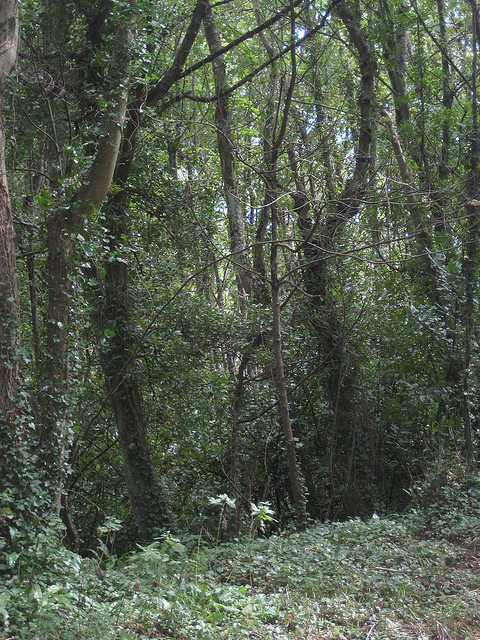
It was as though he had suddenly emerged, by some hidden doorway, into a world entirely composed of vast, cool, silent-growing vegetation, a world where no men, no beasts, no birds, broke the mossy stillness; a world of sap and moisture and drooping ferns; a world of leaves that fell and fell forever, leaf upon leaf;


a world where that which slowly mounted upwards endured eternally the eternal lapse of that which slowly settled downwards; a world that itself was slowly settling down, leaf upon leaf, grass-blade upon grass-blade, towards some cool, wet, dark, unutterable dimension in the secret heart of silence!


Lying upon that rank, drenched grass, he drew a deep sigh of obliterating release. ...Ah! how his human consciousness sank down into that with which all terrestrial consciousness began!...


He was a leaf among leaves...among large, cool, untroubled leaves.... He had fallen back into the womb of his real mother... He was drenched through and through with darkness and with peace.


(From John Cowper Powys, Wolf Solent, Chapter 18, "The School Treat")